
Classroom companion
Arrange an appointment by phone in German: A2 practice
Arrange, move and confirm a German appointment by phone with a complete original A2 dialogue, listening-repair phrases and explained exercises.
Read as Markdown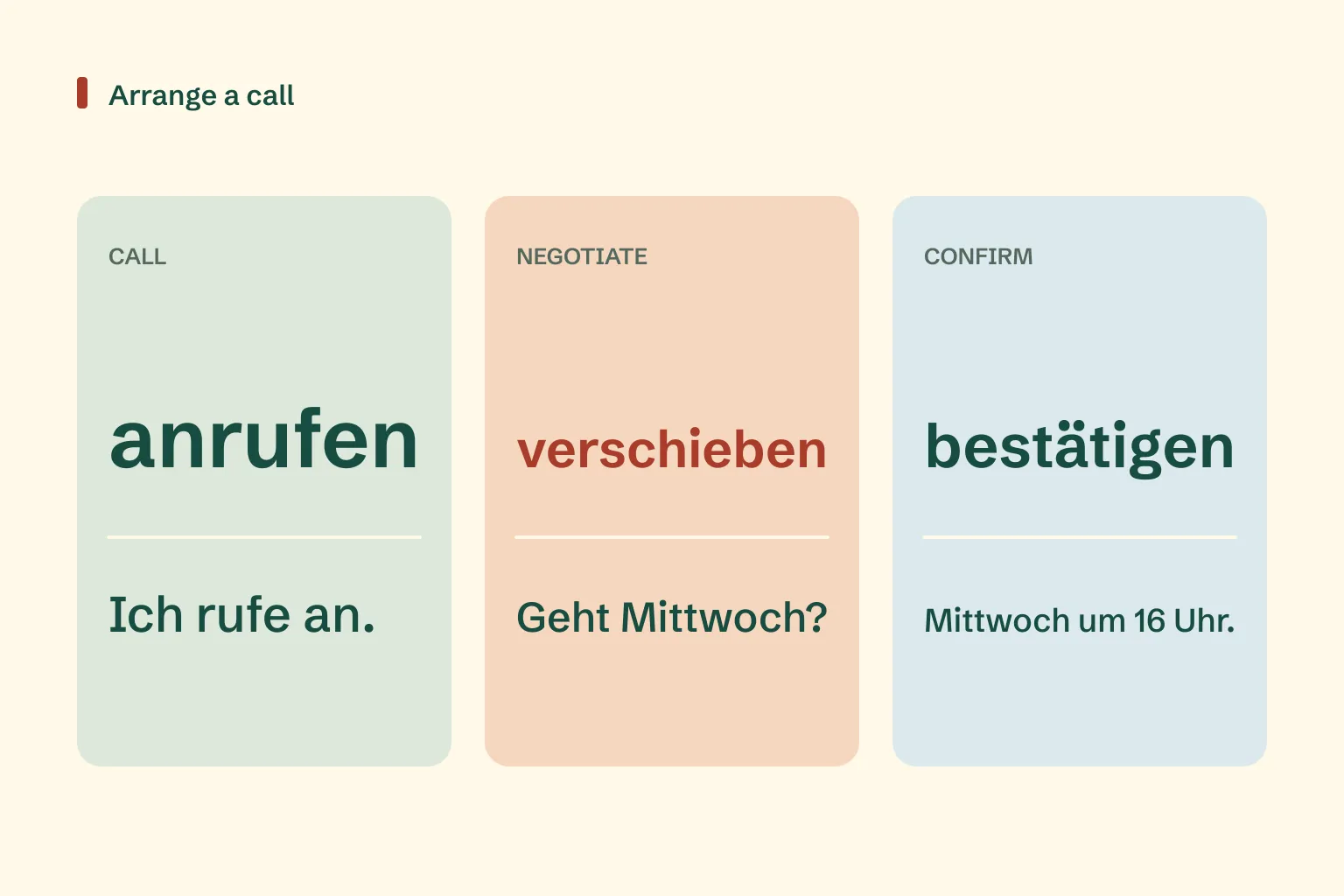
You want a short meeting with your German tutor, but the first suggested time does not work. A successful phone call needs more than saying a time: identify yourself, explain the purpose, discuss an alternative and confirm the final arrangement. Am Dienstag kann ich leider nicht. Hätten Sie am Mittwoch Zeit? means “Unfortunately I cannot on Tuesday. Would you have time on Wednesday?”
Takeaway: A proposal is not a confirmed appointment. Listen for agreement, then repeat the final day, time and location.
Keep four stages on a note card
| Stage | A useful original phrase | Purpose |
|---|---|---|
| Identify yourself | Guten Tag, hier spricht Alex Tran. | Say who is calling. |
| Explain the purpose | Ich rufe wegen unseres Gesprächstermins an. | Say what the call concerns. |
| Negotiate | Könnten wir den Termin verschieben? | Ask to move it. |
| Confirm | Dann sehen wir uns am Mittwoch um 16 Uhr. | State the agreed result. |
Anrufen is separable: Ich rufe an. Verschieben is not separated in this use: Wir verschieben den Termin. To cancel without making a new arrangement, say Ich muss den Termin absagen. Moving and cancelling are different actions, so make the intended outcome explicit.
An original phone dialogue
The appointment and contact details are fictional.
Tutor: Sprachstudio, guten Tag.
Alex: Guten Tag, hier spricht Alex Tran. Ich rufe wegen unseres Termins am Dienstag an.
Tutor: Guten Tag, Herr Tran. Was kann ich für Sie tun?
Alex: Ich kann am Dienstag leider nicht kommen. Könnten wir den Termin verschieben?
Tutor: Haben Sie am Mittwoch um 15 Uhr Zeit?
Alex: Um 15 Uhr bin ich noch bei der Arbeit. Wäre 16 Uhr auch möglich?
Tutor: Ja, 16 Uhr passt. Kommen Sie bitte in Raum 3.
Alex: Entschuldigung, war das Raum 3 oder Raum 4?
Tutor: Raum 3, im Erdgeschoss.
Alex: Danke. Dann Mittwoch um 16 Uhr, Raum 3 im Erdgeschoss.
Tutor: Genau. Bis Mittwoch!
Alex: Vielen Dank. Auf Wiederhören!
Passt means that the suggested time works here. Alex does not accept 15:00 and then silently plan to arrive at 16:00. He states the problem and asks about a new possibility before confirming.
Manage the details you cannot see
A phone call removes visual help. Prepare a small grid with Tag, Uhrzeit, Ort and Name. Fill in only what the other speaker actually says. A blank box is a cue to ask, not permission to invent an address.
Use Einen Moment bitte, ich schreibe das auf (One moment, please, I am writing that down). If the line is unclear, ask Könnten Sie die Raumnummer wiederholen? rather than asking the person to repeat the whole conversation. When spelling a name, give the letters and check any unfamiliar ones separately.
Avoid an ambiguous ending
Vielleicht am Mittwoch means “perhaps on Wednesday.” It is not firm agreement. Respond with a question: Können wir Mittwoch um 16 Uhr fest vereinbaren? (Can we firmly arrange Wednesday at 16:00?). If the other person must check first, ask when or how they will confirm.
For a role-play with classmates, do not use real private phone numbers. The learning target is the language of agreeing and checking a plan, not placing calls to a business. You can speak back to back or use a screen between you to practise without gestures.
Practice
- Which original appointment is Alex moving?
- Why does he reject the first Wednesday proposal?
- What are the final day, time and room?
- Complete: Ich ___ wegen des Termins ___ (anrufen, ich).
- Translate: “Could we move the appointment?”
- Your partner says “Perhaps Friday.” Write a checking question that seeks a firm time.
- Write a courteous closing for a telephone call, rather than an in-person goodbye.
Explained answers and models
- The Tuesday appointment. Alex identifies it at the start; Wednesday is the proposed replacement.
- He is still at work at 15:00. He asks about 16:00 instead of accepting a time he cannot attend.
- Wednesday, 16:00, room 3 on the ground floor. The room correction is confirmed in the dialogue.
- Ich rufe wegen des Termins an. The finite part rufe is second and the separable prefix is last.
- Könnten wir den Termin verschieben? Wir includes both participants in changing the arrangement.
- Können wir Freitag um 10 Uhr fest vereinbaren? The proposed hour can differ; a good answer asks for explicit agreement rather than treating vielleicht as confirmation.
- Vielen Dank. Auf Wiederhören! Danke für Ihre Hilfe. Auf Wiederhören! is another appropriate closing.
Sources and next lesson
Duden on vereinbaren and verschieben support the distinction between arranging and moving an appointment. All dialogue details are original. Review separable verbs, then continue in the A2 path.