
Classroom companion
Spelling your name in German: alphabet and classroom practice
Spell a name in German, distinguish easily confused letter names, handle umlauts and check a partner’s written version with six explained tasks.
Read as Markdown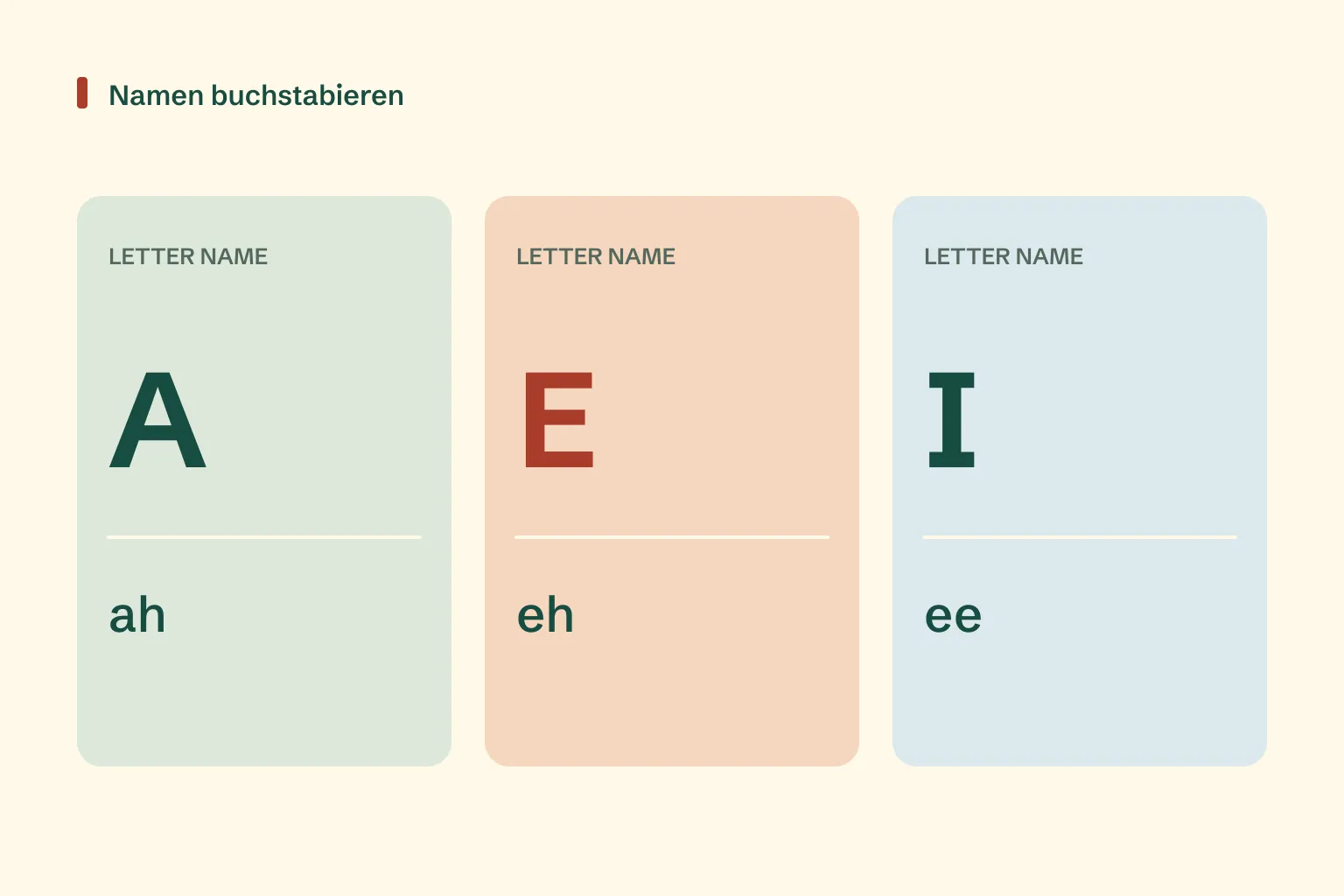
Your teacher asks for your surname, then says, Wie schreibt man das? You need the names of the letters, not the sounds those letters make inside a word. Say your name once, spell it in manageable groups, then check the version your partner writes. This lesson gives you that complete exchange, including a way to repair a mistake.
Takeaway: Spell the written name letter by letter. A letter name is a speaking tool; it is not a pronunciation rule for every word containing that letter.
The alphabet as a practical reference
The English sound cues below are approximate reminders only. English accents differ. Listen to the German alphabet example linked in the sources and compare it with your teacher rather than treating these cues as exact phonetic notation.
| Letters | Approximate German letter-name cues |
|---|---|
| A B C D E | ah, bay, tsay, day, eh |
| F G H I J | eff, gay, hah, ee, yot |
| K L M N O | kah, ell, emm, enn, oh |
| P Q R S T | pay, koo, err, ess, tay |
| U V W X Y Z | oo, fow, vay, iks, üpsilon, tsett |
German E and English “E” are easy to mix up. German I sounds approximately like English “ee”; German E is a different vowel. Likewise, German W is called approximately “vay,” while V is called “fow.” Practise those contrasts separately before attempting a long email address.
The additional written characters ä, ö, ü can be identified as A-Umlaut, O-Umlaut, U-Umlaut when spelling. ß is Eszett or scharfes S. These labels identify characters; they do not mean that an umlaut is pronounced as the plain vowel. Names should retain their actual spelling. Do not silently replace ü with u on a class list.
An original registration exchange
Teacher: Wie heißen Sie? What is your name?
Learner: Ich heiße Nora Kühn. My name is Nora Kühn.
Teacher: Wie schreibt man Kühn? How do you spell Kühn?
Learner: K, U-Umlaut, H, N.
Teacher: K, U, H, N?
Learner: Fast. Mit U-Umlaut: K, Ü, H, N. Almost. With U-umlaut.
Teacher: Kühn. Ist das richtig? Kühn. Is that correct?
Learner: Ja, genau. Danke. Yes, exactly. Thank you.
The learner repairs only the mistaken character. Starting the whole introduction again would make the important correction harder to hear. You can also say Noch einmal, bitte (Once again, please) or Etwas langsamer, bitte (A little more slowly, please). Both are useful classroom chunks you can reuse without changing a verb ending.
A four-minute partner routine
Choose a fictional name if you do not want to share personal details. First, Speaker A says the name naturally. Then A spells it, pausing between the first name and surname. B writes it without looking at a model, reads it back, and asks Ist das richtig? A checks each letter and gives a precise correction if necessary. Swap roles with a new name.
Keep a record of the letter that caused trouble, not just the whole alphabet copied again. For example, write E / I with two short names, Emil / Ida, as your own memory cues. These are practice cues, not a claim to reproduce a standardized telephone alphabet. This lesson covers basic spelling in class, not the separate official spelling standards used by organizations.
Practise it
- Write the individual letters of the fictional surname Beck in order.
- Someone writes Kuhn, but the model name is Kühn. Give a short German correction identifying the missing character.
- Which German letter name has the approximate cue “ee”: E or I?
- A partner speaks too quickly. Give a polite classroom request in German.
- You have written a name and want confirmation. Ask one short question.
- Plan a fictional spelling exchange using Lena Wolf. Include the name, the surname’s letters and a confirmation.
Answers and reasons
- B, E, C, K. Keep the written order. Spelling does not mean pronouncing the surname slowly as one word.
- Mit U-Umlaut, bitte: K, Ü, H, N. The correction distinguishes ü from u. Kühn mit Ü is also an acceptable short repair.
- I. German E has a different letter name. The English cues are approximate, so compare them with a German model.
- Etwas langsamer, bitte or Noch einmal, bitte. The first asks for slower speech; the second asks for repetition.
- Ist das richtig? It checks the written result rather than assuming that hearing was enough.
- Model: Ich heiße Lena Wolf. Wolf: W, O, L, F. Ist das richtig? A partner can answer Ja, genau. Other introductions are possible, but the surname must retain those four letters.
Use it in your next lesson
Make a two-column note headed I said / My partner wrote. Test a second fictional surname, for example Möller. Model repair: Mit O-Umlaut: M, Ö, L, L, E, R. Record repeated letters separately. Follow the A1 learning path for another short speaking task.
Sources and further reading
- Goethe-Institut: free German practice: The A1 alphabet video offers a German sound model; the cues and registration exchange here are original.
- Duden: buchstabieren: Supports the distinction between naming individual letters in sequence and reading the name as a whole.