
Free resources
German genitive articles and noun endings with practice
Choose German genitive articles and noun endings in clear classroom examples. Practise possession, names and noun groups with six explained answers.
Read as Markdown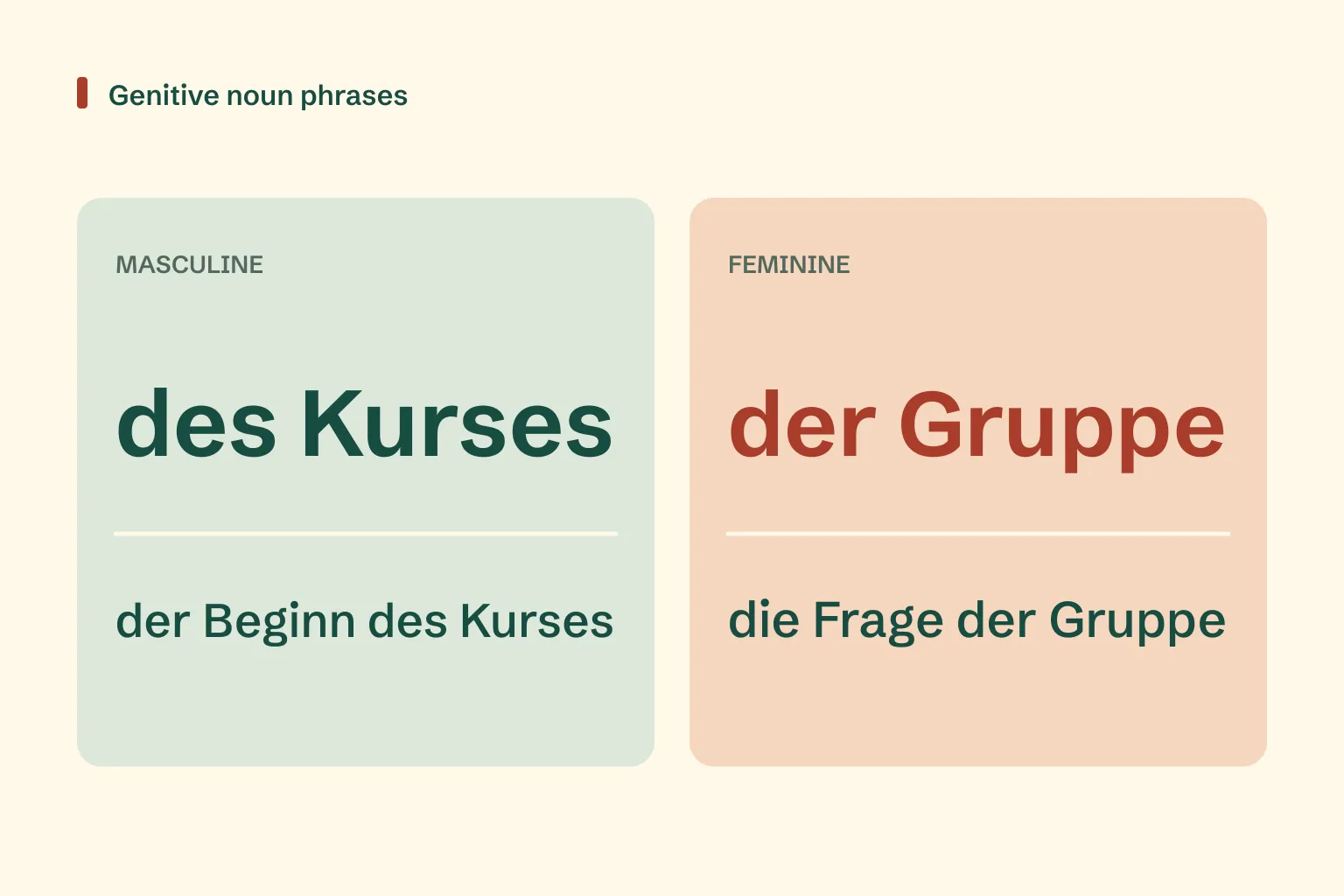
Your course schedule says der Beginn des Kurses. The phrase means “the beginning of the course.” Des Kurses is genitive: it connects one noun to another. In ordinary masculine and neuter singular noun groups, the article changes and the noun often gains -s or -es. Feminine and plural genitive phrases use a different pattern.
Takeaway: In a genitive noun phrase, check three things separately: the noun’s gender or number, the article form, and the noun’s own ending. Genitive means more than literal ownership.
Genitive articles and examples
German genitive noun phrases
Articles and selected noun endings. Suggested level: B1.
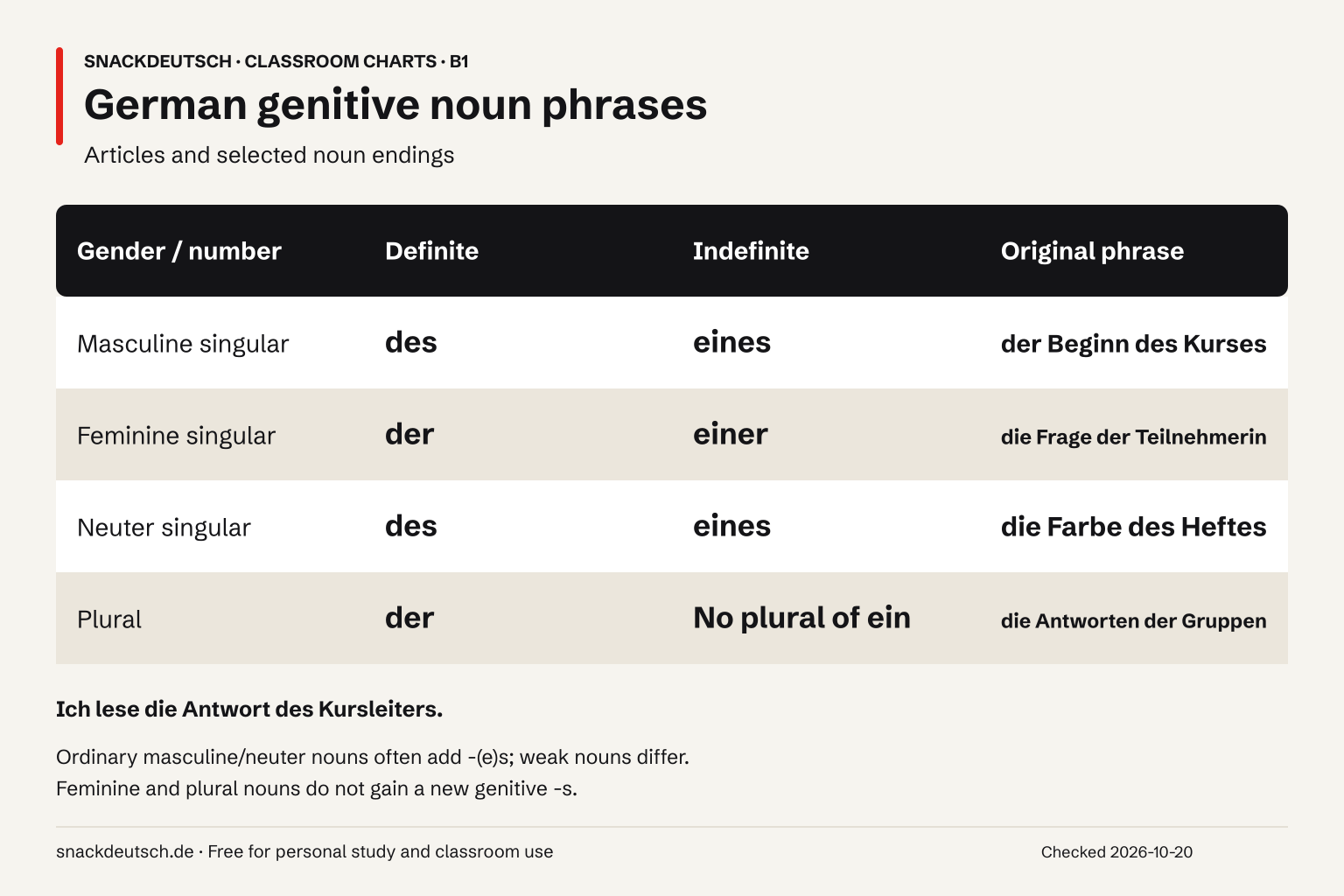
| Gender / number | Definite | Indefinite | Original phrase |
|---|---|---|---|
| Masculine singular | des | eines | der Beginn des Kurses |
| Feminine singular | der | einer | die Frage der Teilnehmerin |
| Neuter singular | des | eines | die Farbe des Heftes |
| Plural | der | No plural of ein | die Antworten der Gruppen |
Ich lese die Antwort des Kursleiters.
- Ordinary masculine/neuter nouns often add -(e)s; weak nouns differ.
- Feminine and plural nouns do not gain a new genitive -s.
Des Kurses is masculine; des Heftes is neuter. The identical article des does not merge those genders. Der Teilnehmerin is feminine singular; der Gruppen is plural. You need the noun as well as the article to interpret the phrase.
An indefinite example is die Frage eines Teilnehmers (the question of a participant). With a feminine noun: die Frage einer Teilnehmerin. There is no plural ein, but you can use a phrase such as die Fragen einiger Teilnehmer when you mean “the questions of some participants.”
Work out which noun is genitive
In Ich lese die Antwort des Kursleiters, the verb lese takes the accusative object die Antwort des Kursleiters. Inside that larger object, des Kursleiters tells you whose answer it is. You do not make the entire phrase genitive simply because one part is.
Compare:
- Die Antwort des Kursleiters ist kurz. The instructor’s answer is short.
- Ich lese die Antwort des Kursleiters. I read the instructor’s answer.
- Ich arbeite mit der Antwort des Kursleiters. I work with the instructor’s answer.
The outer noun Antwort changes its sentence role. The inner genitive phrase des Kursleiters remains the same. Bracket the idea as [Antwort [des Kursleiters]] if a long noun group becomes confusing.
Learn the noun ending with a checked form
Many ordinary masculine and neuter nouns add -s or -es: des Lehrers, des Kurses, des Buches. Short nouns often allow or favour -es, but a syllable-count shortcut does not reliably choose every form. Dictionaries can list variants, such as des Hefts/des Heftes.
Feminine nouns do not gain a genitive -s: der Gruppe, not der Gruppes. Plural nouns also do not gain a new genitive -s just because the phrase is genitive: der Bücher, der Gruppen.
Weak masculine nouns are important exceptions to the ordinary -s pattern: des Studenten, not des Students. Mixed forms such as des Namens need separate attention. A chart of article endings alone cannot predict every noun ending.
Names usually behave differently
For an ordinary personal name that does not end in an s-sound, add -s without an English-style apostrophe: Leas Heft, Amirs Frage. These name phrases normally come before the noun, unlike das Heft der Teilnehmerin.
For a name ending in a written s-sound, an apostrophe marks the possessive form: Max’ Heft. In everyday writing you can also avoid that form with das Heft von Max. Do not write Lea’s Heft merely by transferring the ordinary English pattern.
These examples concern German possessive name phrases. Brand names and certain special constructions can involve additional spelling rules; this lesson does not treat every apostrophe on a sign as the same issue.
Recognize genitive beyond ownership
Die Dauer des Kurses describes a duration; der Inhalt des Textes describes content. A course does not literally own its duration. Translate the relationship naturally rather than forcing “belongs to” into every sentence.
You will also meet genitive after some prepositions in standard writing: während des Unterrichts (during the lesson), wegen des Wetters (because of the weather). Spoken and regional usage can differ. This practice uses the stated written forms and keeps them separate from noun-to-noun possession.
For class notes, save der Beginn des Kurses as a complete phrase. Then change the head noun: das Ende des Kurses. That lets you practise genitive without also changing every part of the sentence.
Six tasks
- Complete: Das ist die Adresse ___ Schule. Use feminine die Schule.
- Complete with the genitive of der Kurs: Der Beginn ___ ist um neun Uhr.
- Complete: Ich lese die Antworten ___ Gruppen. Use plural die Gruppen.
- Use der Student: Die Frage ___ ist interessant.
- Write “Lea’s notebook” and “Max’s notebook” as German name phrases.
- Identify the outer case and inner genitive: Ich spreche mit der Leiterin des Kurses. Which preposition controls der Leiterin, and what does des Kurses modify?
Answers and reasons
- Der Schule. Feminine genitive article is der; Schule gains no -s.
- Des Kurses. Masculine des combines with the checked noun form Kurses.
- Der Gruppen. Plural genitive uses der, without an added noun -s.
- Des Studenten. Student is weak; its genitive singular ends in -en.
- Leas Heft; Max’ Heft. Ordinary Lea gains -s without an apostrophe. Max ends in an s-sound, so the possessive name takes the apostrophe.
- Mit controls dative der Leiterin. The inner phrase des Kurses modifies Leiterin: she is the course’s director or leader. Its genitive does not replace the dative required by mit.
Sources and next practice
Checked on 19 October 2026: University of Texas, genitive, Duden entries for Kurs and Heft declension, and Duden, apostrophe rules. The article does not adopt broad claims that the genitive is disappearing. B1 is an editorial teaching estimate; examples are original.
Compare the four cases in the classroom case guide, then return to the B1 learning path.