
Classroom companion
German classroom instructions: understanding the imperative
Understand German classroom instructions with du, ihr and Sie, check irregular forms such as lies, and practise responding to the task a teacher assigns.
Read as Markdown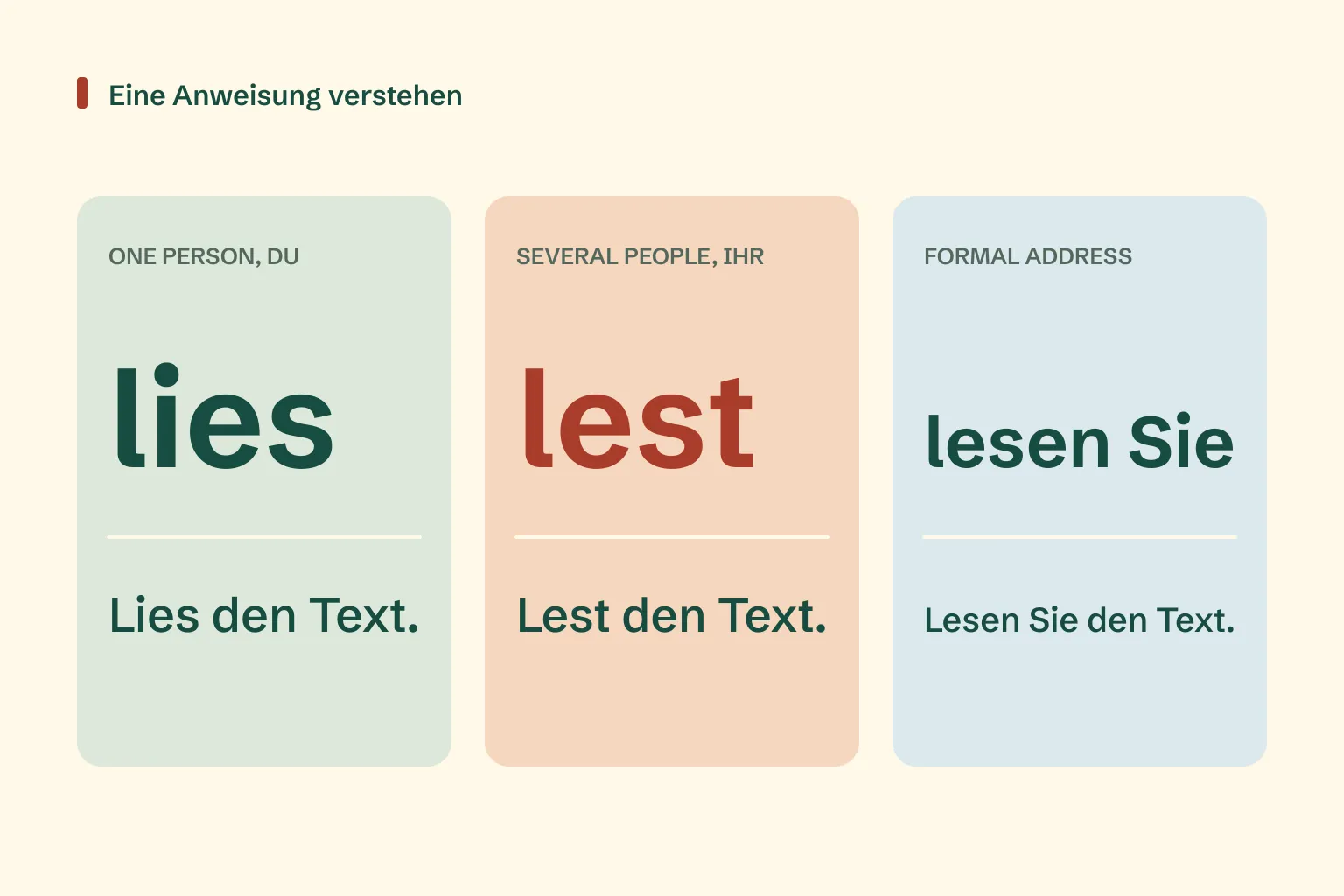
Your teacher says Lesen Sie den Text or Lest den Text. Both ask learners to read, but they use different address forms. To follow a classroom instruction, identify the action, the person or group addressed, and the item to work on. The chart below groups common du, ihr and formal Sie requests, including the irregular singular lies.
Takeaway: Lies addresses one person with du; lest addresses an informal group; lesen Sie uses formal address. Keep Sie in the formal construction.
Classroom instruction chart
German classroom instructions
Du, ihr and formal Sie requests. Suggested level: A1.
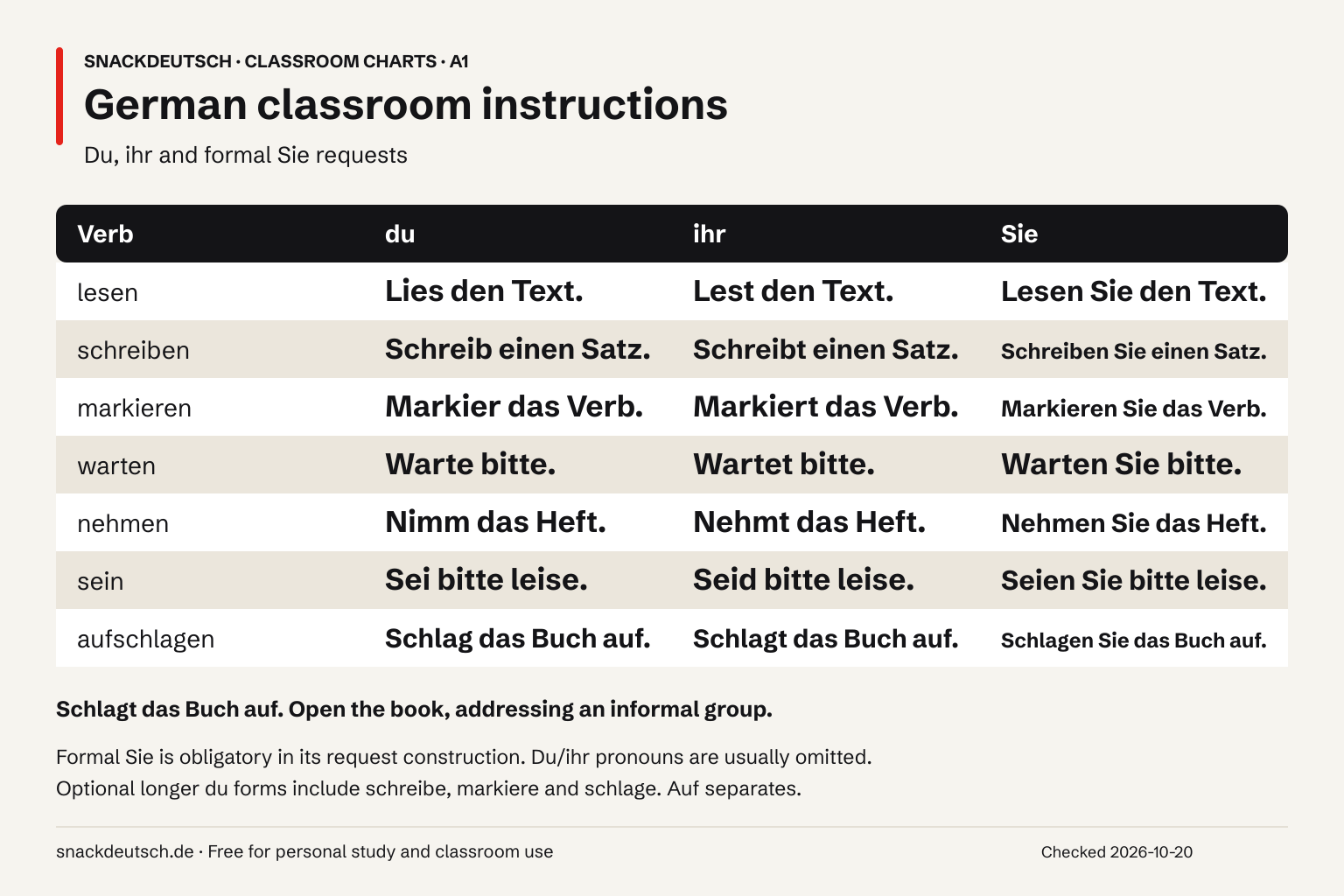
| Verb | du | ihr | Sie |
|---|---|---|---|
| lesen | Lies den Text. | Lest den Text. | Lesen Sie den Text. |
| schreiben | Schreib einen Satz. | Schreibt einen Satz. | Schreiben Sie einen Satz. |
| markieren | Markier das Verb. | Markiert das Verb. | Markieren Sie das Verb. |
| warten | Warte bitte. | Wartet bitte. | Warten Sie bitte. |
| nehmen | Nimm das Heft. | Nehmt das Heft. | Nehmen Sie das Heft. |
| sein | Sei bitte leise. | Seid bitte leise. | Seien Sie bitte leise. |
| aufschlagen | Schlag das Buch auf. | Schlagt das Buch auf. | Schlagen Sie das Buch auf. |
Schlagt das Buch auf. Open the book, addressing an informal group.
- Formal Sie is obligatory in its request construction. Du/ihr pronouns are usually omitted.
- Optional longer du forms include schreibe, markiere and schlage. Auf separates.
Lesen means read, schreiben write, markieren mark/highlight, warten wait, nehmen take, and leise sein be quiet. In beginner teaching, these are commonly grouped as imperative or instruction forms. More technical grammar distinguishes the formal Sie request construction from the morphological du/ihr imperative. You can use the chart without treating the three columns as identical grammatical categories.
Build the forms carefully
For many verbs, the du instruction uses the stem with an optional -e: schreib / schreibe, markier / markiere. The table uses the shorter versions where natural. Warten uses warte in standard singular instructions; simply dropping every ending would create wart as a poor model for this beginner pattern.
With the e-to-i/ie group, learn the changed form: lesen → lies, nehmen → nimm. Do not create les or nehme as the target informal singular instructions. The ihr form matches the usual ihr present form but normally omits the pronoun: ihr lest → Lest den Text. The formal request retains Sie: Lesen Sie den Text. Sein has special forms sei, seid, seien Sie.
Aufschlagen means “open” when referring to a book. Its prefix separates in the chart’s direct instructions: Schlag das Buch auf (Open the book). The opening action and final auf belong together. Schlage das Buch auf is also a standard longer du form. Keep the page with the same instruction when needed: Schlagen Sie das Buch auf Seite zehn auf (Open the book at page ten). The separable-verb guide gives more main-clause examples.
Find the actual task, not only the verb
Markieren Sie das Verb means “Mark the verb.” Markieren Sie die Nomen means “Mark the nouns.” The opening action is the same; the object changes the task. If you recognize markieren but ignore das Verb, you can perform the wrong exercise confidently.
Try this sequence: Lies den Satz. Markier das Verb. Schreib eine Frage. Read the sentence. Mark the verb. Write a question. With the working sentence Lea lernt heute Deutsch, a completed response could be lernt marked, then Lernt Lea heute Deutsch?. The task requires a yes/no question here only if the teacher or worksheet specifies that type; Wann lernt Lea Deutsch? is a different valid information question.
Ask for help without guessing
Was sollen wir machen? means “What are we supposed to do?” Noch einmal, bitte asks for repetition. Sollen wir das Verb markieren? checks a specific interpretation: “Are we supposed to mark the verb?” A useful clarification mentions the part you did understand.
The presence of an imperative does not automatically make a sentence rude. Classroom context, tone and bitte matter. Conversely, adding bitte does not explain an unclear instruction. This guide covers common direct classroom requests and one book-opening example, rather than the full range of reflexive and separable verbs.
Practise it
-
Give the du instruction for “Read the text.”
-
Change Schreib einen Satz to an instruction for an informal group.
-
Complete the formal request: ___ Sie bitte leise. Use sein.
-
A task says Markieren Sie das Verb for Lea lernt heute Deutsch. Which word should be marked?
-
Correct Nehme das Heft as the target du instruction.
-
Give a clear three-step classroom task for an informal group: read the sentence, mark the verb, write a question. Then give a model yes/no question for the working sentence.
-
Ask an informal group to open the book, using aufschlagen. Identify the separated prefix.
Answers and reasons
-
Lies den Text. Lesen changes its vowel to ie in this singular imperative.
-
Schreibt einen Satz. Use the ihr form without needing an explicit ihr.
-
Seien Sie bitte leise. Formal Sie stays present; sein has the special form seien.
-
Lernt. It is the finite verb describing Lea’s activity. Lea is the subject, not the verb.
-
Nimm das Heft. Nehmen uses nimm for this du instruction.
-
Lest den Satz. Markiert das Verb. Schreibt eine Frage. Model question: Lernt Lea heute Deutsch? The instructions consistently address an informal group; the question preserves the original facts.
-
Schlagt das Buch auf. The group form is schlagt; auf is the separated prefix and closes the instruction. Schlagt das Buch auf Seite zehn auf is also correct if adding that page.
Use it in your next lesson
Copy one instruction from your course notes and identify action, addressee, object. Model: Lesen Sie den Text → read, formal you, the text. If a word is unclear, ask Was bedeutet „markieren“? (What does markieren mean?). Keep the full instruction beside the verb in your class vocabulary notes.
Sources and further reading
- IDS: imperative: Reference for singular/plural imperative forms and changed vowels.
- IDS: imperative and request constructions: Reference for the distinct formal Sie construction and its obligatory subject.
- Duden: aufschlagen: Dictionary reference for the meaning “open a book” used in the separable instruction.