
Classroom companion
Write a simple German email about your next class
Write a short German email to a classmate with a reason, clear class details and one useful question, then check an original model and explained tasks.
Read as Markdown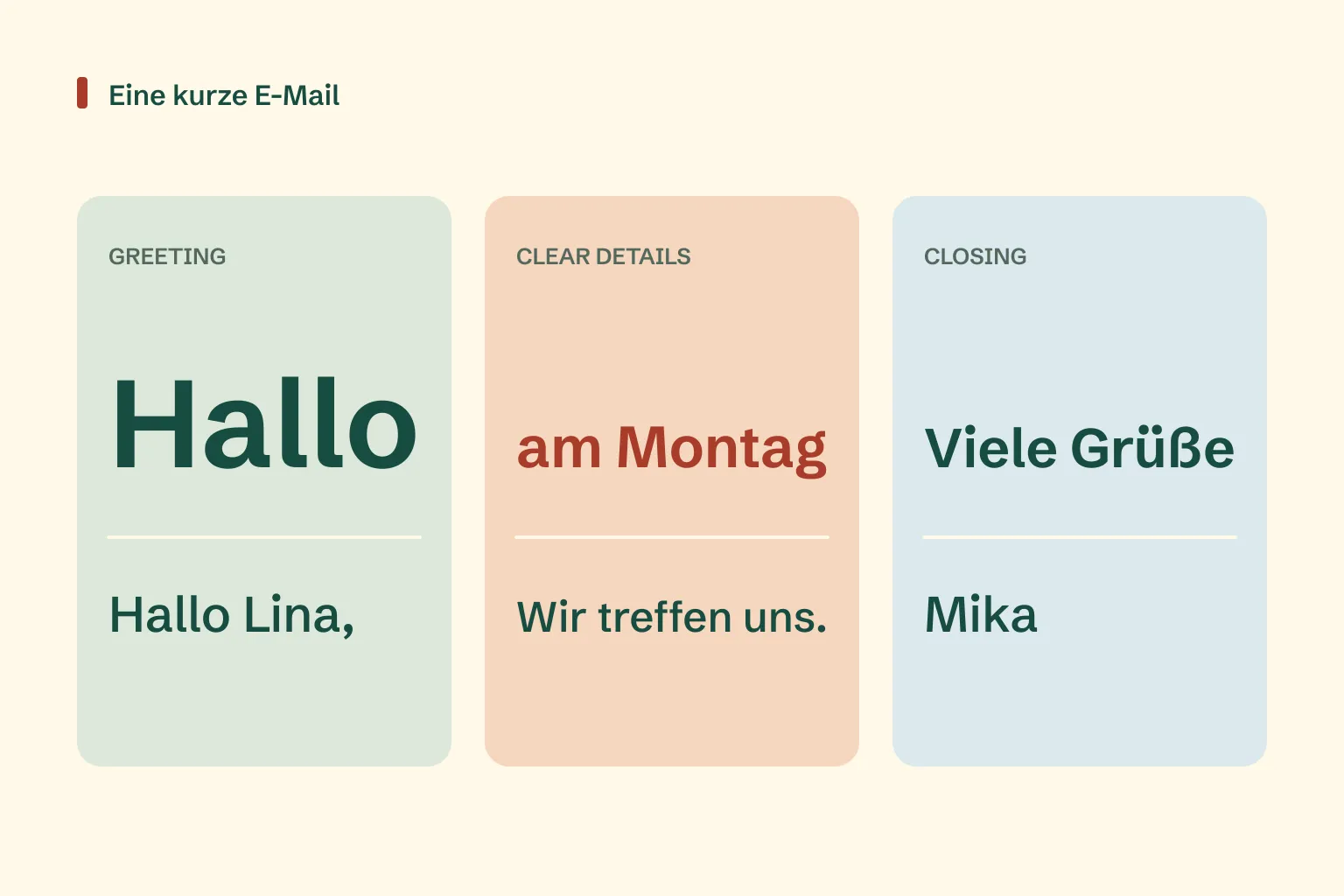
Your classmate missed the final announcement, so you want to email the next meeting details. A simple German email can do four jobs: greet the person, say why you are writing, give the day and time, and ask one clear question. Use short sentences you can check. The model below is an original class message, not a copied examination answer.
Takeaway: Answer the reader’s practical question first: when, where and what to bring. An impressive sentence is less useful than an unambiguous meeting time.
A complete original email
Situation: Mika and Lina are classmates who use du. Their practice meeting is on Monday at 17:30 in the library, before a course starting at 18:00. Mika wants Lina to bring her notebook. These details are invented for the exercise.
Betreff: Deutsch üben am Montag
Hallo Lina,
am Montag üben wir zusammen. Wir treffen uns um 17:30 Uhr in der Bibliothek. Unser Deutschkurs beginnt um 18 Uhr. Bringst du bitte dein Heft mit? Ich habe das Kursbuch. Passt die Zeit für dich?
Viele Grüße
Mika
English meaning: Subject: Practising German on Monday. Hello Lina, on Monday we practise together. We meet at 17:30 in the library. Our German class starts at 18:00. Could you bring your notebook, please? I have the coursebook. Does the time work for you? Best wishes, Mika.
Why each part earns its place
| Part | Purpose | Useful model |
|---|---|---|
| Subject | identify the topic | Deutsch üben am Montag |
| Greeting | address the reader | Hallo Lina, |
| Plan | give a day and action | Am Montag üben wir zusammen. |
| Details | fix time and place | Um 17:30 Uhr in der Bibliothek. |
| Request | say what is needed | Bringst du bitte dein Heft mit? |
| Check | allow a response | Passt die Zeit für dich? |
| Closing | finish courteously | Viele Grüße / Mika |
The model begins the line after the greeting with am, lowercase, because the comma continues the sentence. If you rewrite the plan as a standalone sentence outside that letter frame, write Am Montag …. The nouns Montag, Bibliothek, Deutschkurs and Heft remain capitalized inside sentences.
Mitbringen separates in the question Bringst du … mit?. The final mit belongs to the verb, not to the notebook. The sentence is a polite question request, so it has a question mark. Passt die Zeit für dich? invites a real answer instead of assuming the other learner is available.
Change the message without copying blindly
If the meeting moves to Tuesday, change both the subject and the body. A subject saying Monday with a body saying Tuesday makes the reader choose between contradictory details. If the location moves, replace the place phrase as a whole: im Café, in der Bibliothek, vor dem Kursraum. Do not swap a noun into a memorized preposition-and-article frame without checking it.
A message to a teacher who uses Sie needs a different address and corresponding pronouns: Guten Tag Frau Roth, and Können Sie mir bitte helfen? are examples. Do not mix du, dein, Sie and Ihr casually. This lesson’s full model is intentionally between classmates so its register stays consistent.
A useful editing pass
Read your email once for facts before checking grammar. Circle the day, underline the time and box the location. Then check each sentence has a finite verb and each request has enough information. Finally, imagine the reply: could the classmate confirm the plan or explain which detail needs changing?
This lesson offers beginner communication practice. It does not claim to meet every current examination task, scoring rule or word limit. Use the official examination provider’s own materials for the exact test you intend to take.
Practise it
- Identify the meeting time and the class start time. Why should they have separate labels?
- Correct only the capitalization after this greeting: Hallo Lina, Am Montag üben wir.
- Complete the request with the separated part: Bringst du bitte dein Heft ___? Use mitbringen.
- Replace am Montag with on Tuesday in German. Mention two places in the email that need updating.
- Give one short German question checking whether the time works for Lina.
- Write a new email from Ada to Ben: meet Wednesday at 16:00 in the library, ask Ben to bring a pen. Use du, a subject and a closing.
Answers and reasons
- Meeting 17:30; class 18:00. Separate labels prevent the reader arriving at the practice meeting only when the class begins.
- Hallo Lina, am Montag üben wir. After the greeting’s comma, the continued text starts lowercase unless the word independently needs a capital.
- Mit. Mitbringen separates in this finite question: Bringst du … mit?
- Am Dienstag. Update both the subject and body so they agree.
- Passt die Zeit für dich? Hast du um 17:30 Uhr Zeit? is another clear check.
- Model: Betreff: Treffen am Mittwoch. Hallo Ben, wir treffen uns am Mittwoch um 16 Uhr in der Bibliothek. Bringst du bitte einen Stift mit? Passt die Zeit für dich? Viele Grüße, Ada. Other wording is fine if all supplied details and consistent informal address are present.
Use it in your next lesson
Write a message about a fictional class change. Model opening: Hallo Noor, unser Kurs beginnt am Freitag um 19 Uhr. Add a place and one question that the recipient can answer. Keep a corrected version in your course notebook; compare it with your first draft to see which ambiguity you removed.
Sources and further reading
- Goethe-Institut: A1 writing model test: Official writing practice; this lesson uses a different original prompt and is not a scoring guide.
- Duden: capitalization: Reference for nouns, sentence beginnings and forms of address.