
Classroom companion
How to remember German vocabulary between lessons
Use a manageable routine to revisit your German course words: recall, check, make a sentence, and bring one useful question back to class.
Read as Markdown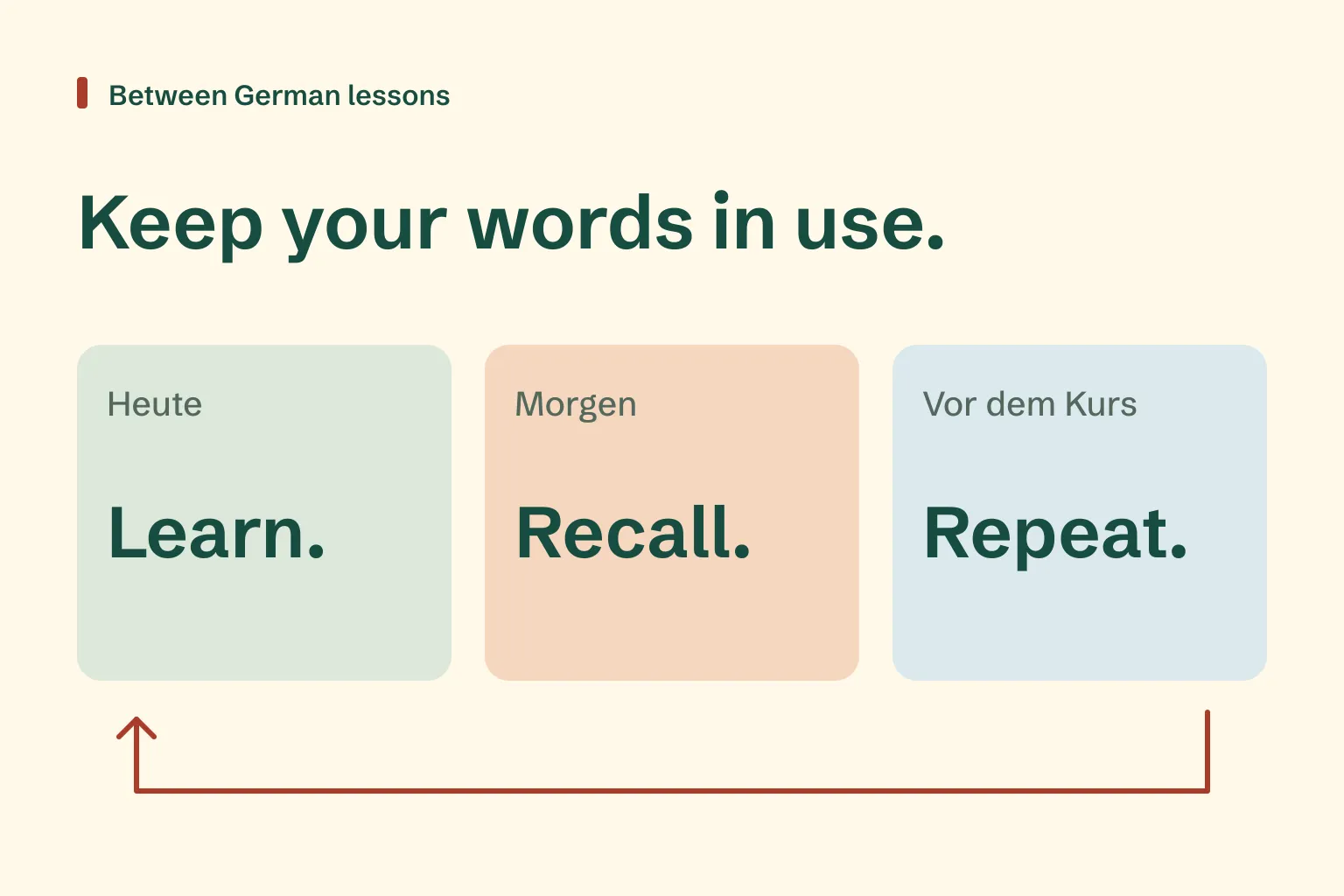
To keep German vocabulary active between lessons, revisit a small set of your own course words and try recalling them before looking at the answers. Check mistakes, use the words in short sentences, and return to the difficult items later. The routine below is adjustable; it is not a promise of perfect memory or a scientifically optimal timetable.
Choose a set you can finish
After class, you may have twenty new words and very little energy. Choose five that connect to the next task in your course. For a lesson about appointments, those might be der Termin, der Ausweis, das Formular, ausfüllen, and unterschreiben.
Put the remaining words in a place you can revisit. They are not lost simply because they are not today’s review set. A short, checked list gives you a clear stopping point. An ever-growing pile can make every session feel unfinished.
Use a recall–check–use loop
First, cover the German and try to produce the word or phrase from a cue. “The form, including its article” should lead to das Formular. Give yourself a moment to answer before turning the card over.
Next, check. If you said der Formular, the meaning was available but the gender needs work. Say the corrected phrase aloud and keep that detail visible in your note. Do not simply mark the entire entry “bad” and move on without understanding the error.
Finally, use it: Ich fülle das Formular aus: I fill in the form. If you can recall a translation but cannot build the sentence, add a phrase prompt. You may need contextual practice more than another isolated definition.
A week you can adapt
| Moment | Small task | Result to look for |
|---|---|---|
| After the lesson | Select and check five entries | A usable set, with unknowns marked |
| The next day | Try the prompts without looking | Find the details you cannot yet recall |
| A later short session | Make three connected sentences | Use words outside a list |
| Before the next lesson | Review hard items and one question | Arrive with something specific to ask |
These are convenient moments, not fixed intervals everyone must follow. If your class meets daily, compress the routine. If it meets weekly, spread the work across the days available. An app’s review schedule can handle timing for individual cards; your notebook can preserve the wider lesson context.
Change the task when review stops helping
Repeatedly reading the same answer can feel comfortable. Test whether that familiarity transfers: hide the answer, change the cue, or explain the sentence in your own words. A different task may reveal a detail you were skipping.
For example, after practising einen Termin vereinbaren, try “I would like to reschedule my appointment.” You now need Ich möchte meinen Termin verschieben. The new sentence checks whether you can distinguish two related phrases instead of treating every appointment verb as interchangeable.
Do not change every part at once. If vocabulary, tense, case, and word order are all new, it becomes hard to tell why you got stuck. Keep the structure familiar while adding one new challenge.
Put the words into a small story
A story need not be long: Ich habe morgen einen Termin. Ich suche meinen Ausweis. Zum Glück liegt er in meiner Tasche. I have an appointment tomorrow. I look for my ID. Luckily, it is in my bag.
The story gives the words a relationship. You can retell it, change the location of the ID, or ask a partner what happens next. Our A2 reading practice shows how a short scene becomes a vocabulary and speaking exercise.
For a longer follow-up, use the B1 group-project story. Its questions and short retelling session ask you to explain a scheduling problem, the agreed plan and the reasons it works.
SnackDeutsch combines course-word organization, review, and optional vocabulary stories. You can also follow this routine with paper cards. The important part of this particular exercise is the action you perform with the words, not a streak counter or the number of cards collected.
If you miss a few days
Resume with a small selection. You do not have to “repay” every missed session before returning to your current course. Start with words you need tomorrow and check older items as time allows.
When a word repeatedly fails, inspect the entry. Is the translation too broad? Did you leave out the article? Does the prompt allow several answers? Repairing the card may be more useful than repeating the same confusing question.
Bring one question back to class
A practical question is “Why is it einen Termin here?” or “Can I use verschieben for a meeting?” Those questions connect your practice to the teacher’s explanations.
Download the checklist and cross off actions, not promises such as “remember everything.” Then use the notebook template to keep corrections next to the original context.
About this routine
This is an original practice plan, not a clinical or experimental claim about memory. It uses recall, checking, and context as concrete study tasks without prescribing universal intervals or guaranteed results. For card mechanics, the Anki introduction explains how answer ratings affect scheduled review.