
Classroom companion
German classroom practice pack: choose a task for your next lesson
Use a complete original German classroom practice pack with six tasks covering class details, noun forms, sentence order, instructions, reading and a reply.
Read as Markdown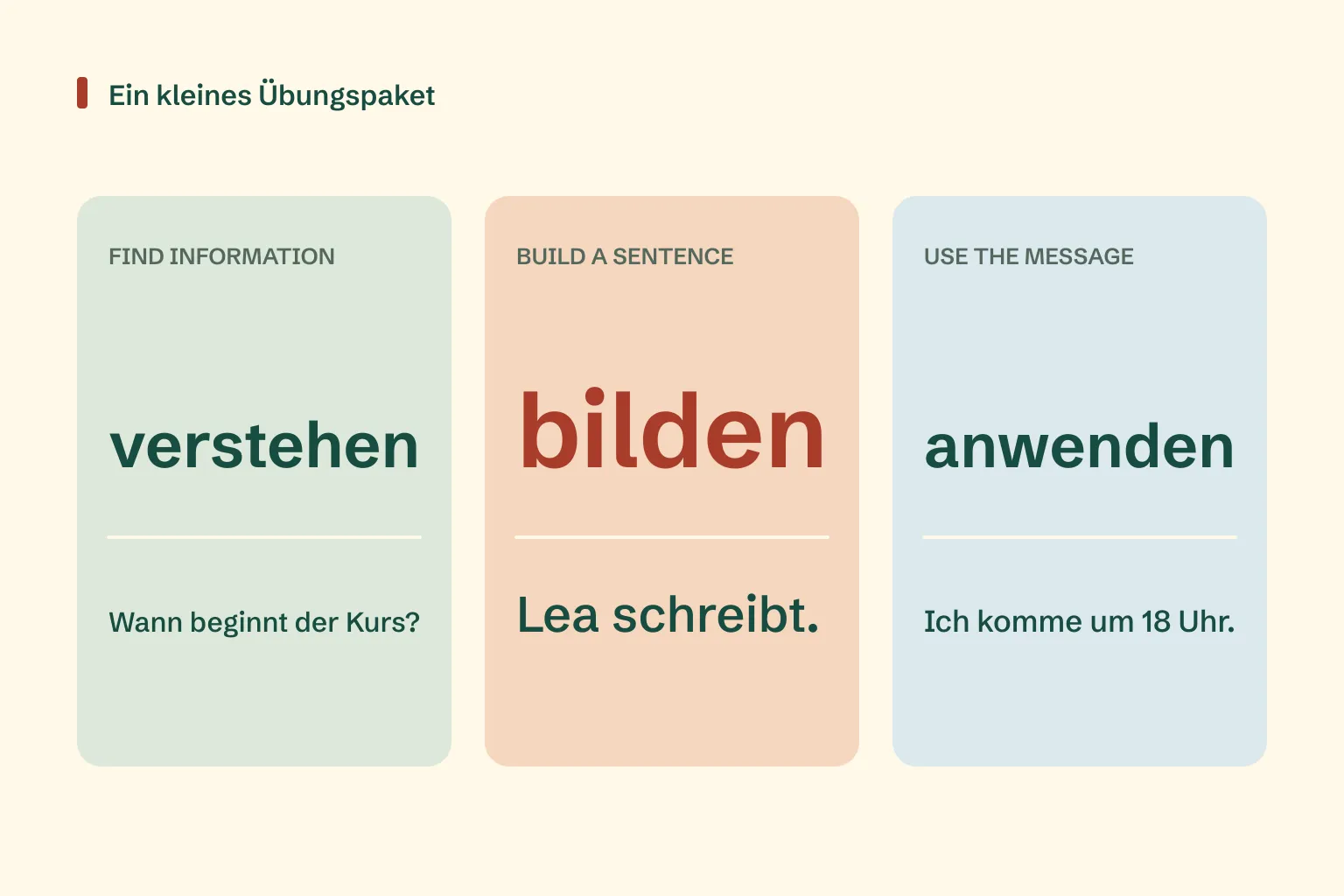
Use this German classroom practice pack when you want a short session that connects several beginner skills. The supplied class card, desk vocabulary, message and mini reading contain everything needed for the six tasks. Find information, build a question, understand an instruction and write a reply. The pack is an original synthesis activity, with explained answers and a complete downloadable worksheet.
Takeaway: Choose the task that matches a real gap, then finish by using its result in a new sentence. You do not need to complete every activity in one sitting.
All working material
Fictional class card: Deutschkurs, Raum 4, Donnerstag, 18:15 Uhr. Bring one notebook and two pens. Partner: Lea.
Working sentence: Lea schreibt heute einen Satz.
Desk list: das Heft, die Hefte (notebook); der Stift, die Stifte (pen); das Buch, die Bücher (book); die Tasche, die Taschen (bag).
Short message: Hallo Amir, wir üben am Donnerstag vor dem Kurs. Wir treffen uns um 18 Uhr vor Raum 4. Bringst du bitte dein Heft mit? Viele Grüße, Lea.
Mini reading: Amir kommt um 18 Uhr. Sein Heft ist in der Tasche. Lea hat zwei Stifte. Zusammen lesen sie drei Sätze. Um 18:15 Uhr gehen sie in Raum 4. Der Deutschkurs beginnt.
English support: The class card says German course, room four, Thursday, 18:15. The message asks Amir to meet before class, at 18:00 outside room four, and bring his notebook. In the mini reading, Amir arrives at 18:00, his notebook is in the bag, Lea has two pens, they read three sentences, and they enter room four at 18:15. Use the German first; return to this support if you cannot identify a key fact.
Choose a focused route
| Your current difficulty | Start with | What to check |
|---|---|---|
| Missing a time or room | task 1 | keep meeting and course time distinct |
| Forgetting noun forms | task 2 | article, singular and plural |
| Losing the verb position | task 3 | finite verb and sentence type |
| Following the wrong instruction | task 4 | action plus object |
| Guessing while reading | task 5 | support your answer from the text |
| Writing a vague reply | task 6 | confirm the exact plan |
For a ten-minute session, choose two tasks and check their answers. For a longer pair activity, each person chooses three and explains one correction to the other. The times are suggested session formats, not a learning-speed claim. If a task is already easy, change one detail and do it without looking at the model.
Keep the skills connected
The same Heft appears in the noun list, the message and the mini reading. That repetition has a job: it lets you carry a word from a dictionary-style entry into a request and then into a scene. Der Stift, die Stifte similarly connects a singular object with the two pens Lea has.
The two clock times also have different jobs. 18 Uhr is the practice meeting; 18:15 Uhr is the class start. A correct reply has to preserve that distinction. A phrase can be grammatically well formed and still communicate the wrong plan if you choose the wrong fact.
Check a response in two passes
First check meaning: did you answer the actual question and retain the class details? Then check form: finite verb, article, plural or question mark. For a longer reply, correcting every possible feature at once can hide the one change you were practising. Mark one useful correction and use it immediately in another sentence.
This is A1-oriented guided practice, not a placement test or a complete curriculum. The sample tasks do not certify a CEFR level or predict an examination score. Use the worksheet on paper or copy the working material into your notes.
Practise it
- Use the class card and message to write three labelled facts in German: day, meeting time, course start time.
- Write singular article and plural for Heft and Stift, then translate “two pens.”
- Turn Lea schreibt heute einen Satz into a yes/no question. Then ask an information question about what she writes.
- Follow Markieren Sie das Verb for the working sentence. Give the word, then change the instruction to an informal group.
- Reading check: are the claims Amir has no notebook and Lea has two pens true or false? Support each answer with a phrase.
- Reply to Lea as Amir. Confirm Thursday at 18:00 outside room 4 and say you will bring the notebook. Use a greeting and closing.
Answers and reasons
- Tag: Donnerstag. Treffen: 18 Uhr. Kursbeginn: 18:15 Uhr. The meeting takes place before the course. Labelling avoids treating both times as one event.
- Das Heft, die Hefte; der Stift, die Stifte; zwei Stifte. Two requires the plural form.
- Schreibt Lea heute einen Satz? Was schreibt Lea heute? In the yes/no question the finite verb is first. In the information question was comes first and schreibt follows.
- Schreibt. Markiert das Verb. The finite verb in the working sentence is schreibt. Markiert is the instruction for an informal group.
- First false: Sein Heft ist in der Tasche. Second true: Lea hat zwei Stifte. Use the mini reading’s facts rather than guessing from a missing-item story elsewhere.
- Model: Hallo Lea, danke. Wir treffen uns am Donnerstag um 18 Uhr vor Raum 4. Ich bringe mein Heft mit. Viele Grüße, Amir. Equivalent wording is fine if it confirms the meeting, not only the 18:15 class time, and retains mit at the end of the mitbringen statement.
Use it in your next lesson
Make a second version of the class card with a different day and time. Update the message and reply so all three agree. Model: Freitag, Treffen 17 Uhr, Kurs 17:15 Uhr. Keep a single correction in your personal vocabulary notebook, then choose the next topic from the A1 learning path.
Sources and further reading
- Goethe-Institut: A1 practice materials: Official examples of beginner skill practice; this pack uses original prompts and is not a mock exam.
- UT: questions: Reference for direct question forms used in the sentence-building task.
- IDS: imperative: Reference for the instruction-form task.