
Classroom companion
Explain a travel problem in German: B1 conversation practice
Explain a travel problem in German using a fictional missed connection. Practise facts, a clear question and confirmation with a B1 dialogue and explained tasks.
Read as Markdown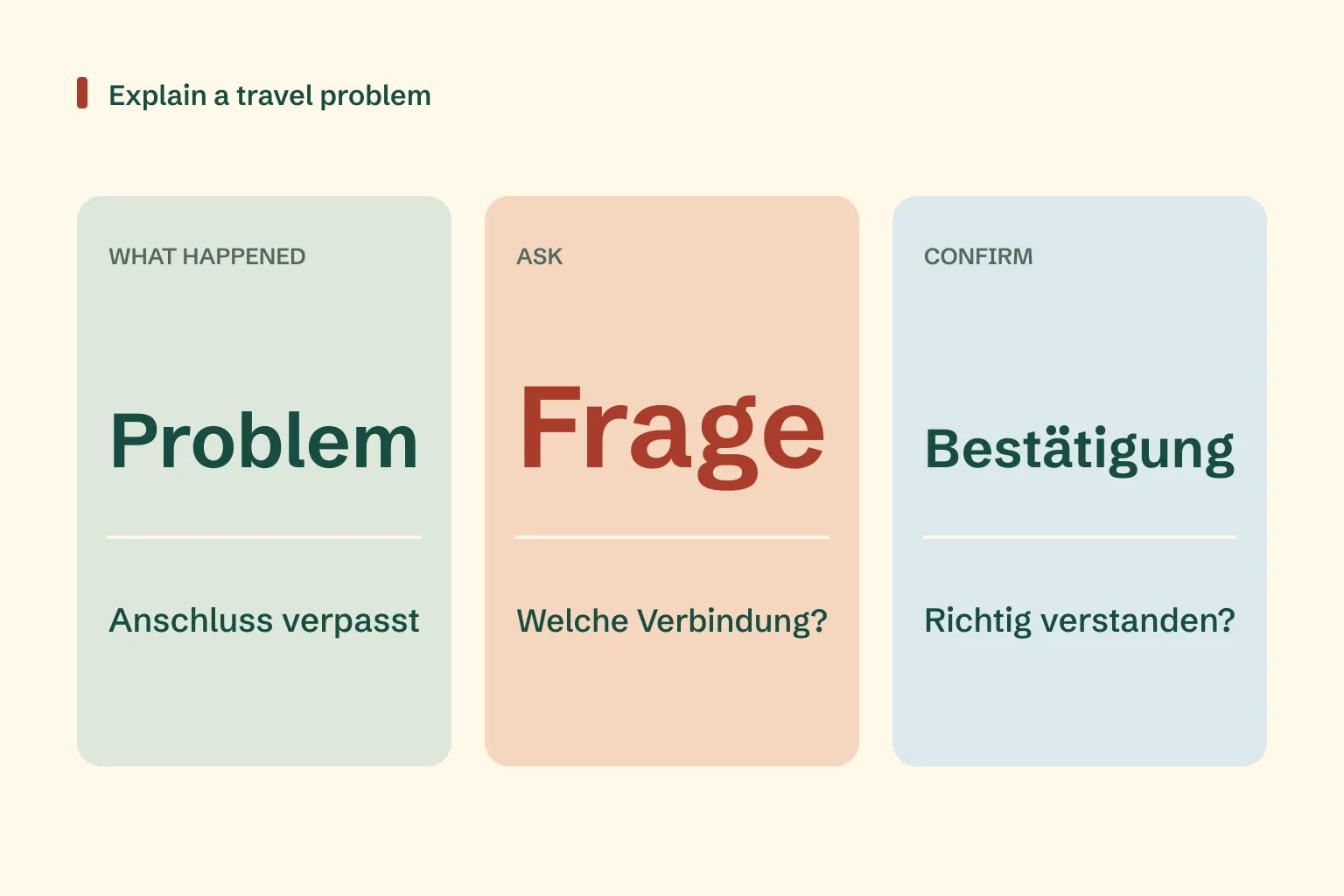
Your train arrives late and the connection you planned to take has left. At the information desk, the first task is to make your situation understandable: where you want to go, what happened and what information you need. This B1 conversation lesson uses a completely fictional journey. The language remains useful without making claims about actual timetables, ticket validity or passenger rights.
Takeaway: Give destination + observed problem + request, then repeat the important details of the answer. Ask the operator to check rules that you cannot infer from a practice dialogue.
The fictional travel situation
You are travelling to Lindenstadt, an invented destination. Your first train arrived twenty minutes late, and you missed the connection. You need to arrive before 18:00 for a class presentation. You have a ticket for the original journey, but you do not know whether it is valid on a different train.
The times, platform and train labels below exist only inside this exercise. For a real trip, check live information and the conditions of your actual ticket. Nothing in this lesson establishes a right to take another service or receive compensation.
An original information-desk dialogue
Reisende: Guten Tag. Ich möchte nach Lindenstadt fahren. Mein Zug hatte zwanzig Minuten Verspätung, deshalb habe ich den Anschluss verpasst.
Mitarbeiter: Welche Verbindung wollten Sie nehmen?
Reisende: Den Regionalzug um 16:10 Uhr. Ich muss möglichst vor 18 Uhr in Lindenstadt sein. Welche Verbindung kann ich jetzt nehmen?
Mitarbeiter: In diesem Beispiel fährt um 16:35 Uhr ein Zug von Gleis 4. Er kommt um 17:40 Uhr an.
Reisende: Muss ich dabei noch einmal umsteigen?
Mitarbeiter: Ja, einmal in Eichenau. Dort haben Sie zwölf Minuten Zeit.
Reisende: Ich habe eine Fahrkarte für die ursprüngliche Verbindung. Können Sie bitte prüfen, ob ich sie für diesen Zug benutzen darf?
Mitarbeiter: Ich prüfe die Bedingungen Ihrer Fahrkarte. Bitte zeigen Sie mir das Ticket.
Reisende: Danke. Habe ich Sie richtig verstanden: Abfahrt um 16:35 Uhr von Gleis 4 und ein Umstieg in Eichenau?
Mitarbeiter: Genau. Bitte achten Sie trotzdem auf die aktuellen Anzeigen.
The staff member has not yet answered the ticket-validity question. Ich prüfe … promises to check, not that the ticket is valid. That distinction matters when you interpret a conversation.
Useful chunks and their jobs
| Chunk | Meaning | Job in the conversation |
|---|---|---|
| den Anschluss verpassen | miss the connection | State what happened. |
| Verspätung haben | be delayed | Explain the cause. |
| Welche Verbindung …? | which connection …? | Ask about the route option. |
| noch einmal umsteigen | change once more | Check the number of changes. |
| die Bedingungen prüfen | check the conditions | Request verification rather than assume. |
| Habe ich Sie richtig verstanden? | Have I understood you correctly? | Confirm important information. |
Der Anschluss can mean the connecting service in this context. Umsteigen describes changing vehicles. Do not use aussteigen alone when you mean to transfer; it only says you get off.
For vocabulary notes, keep den Anschluss verpassen as a chunk. The article den makes the accusative object visible. Ich habe den Anschluss verpasst uses haben, while ich bin in Eichenau umgestiegen uses sein for that travel event.
Tell the story in a useful order
A long explanation about breakfast, the weather and your whole course may hide the travel question. Start with the destination. Add the missed connection and the relevant deadline. Then ask a question the staff member can answer.
Ich möchte nach Lindenstadt. Mein Zug war verspätet und ich habe den Anschluss verpasst. Welche Verbindung kommt vor 18 Uhr an?
You can explain more if asked. The deadline is useful because it narrows the options. Avoid claiming certainty such as Ich werde garantiert um 17:40 Uhr ankommen; even in real information, expected arrival times can change.
Repair a misunderstanding
If you hear 16:35 but are unsure, ask Haben Sie sechzehn Uhr fünfunddreißig gesagt? If you hear a place name incorrectly, ask Können Sie den Namen bitte aufschreiben? If the answer contains unfamiliar ticket terms, say Was bedeutet das für meine Fahrkarte?
Repeating a time is not a failure. It is a practical way to confirm a detail that changes your next action. Write a short confirmation note: 16:35 / Gleis 4 / Eichenau / Ticket noch prüfen. The last item preserves what remains unresolved.
Six tasks
- Why did the traveller miss the connection?
- What arrival deadline matters to the traveller?
- In the fictional answer, how many changes are needed and where?
- Has the staff member confirmed that the existing ticket is valid? Explain.
- Make a courteous request to check whether the ticket can be used. Use ob and darf.
- Role-play a new fictional situation: your bus to a course is cancelled; you want to reach Nordhaus before 09:00; you do not know the next departure. Give the problem and ask two specific questions. Your partner may invent an alternative and must label its details fictional.
Answers and models
- The first train arrived twenty minutes late. This caused the missed connection in the supplied scenario.
- Before 18:00. The traveller has a class presentation.
- One change in Eichenau, with twelve minutes in the exercise. These are fictional details, not travel information.
- No. The staff member says they will check the ticket conditions and asks to see it. Do not interpret that as permission.
- Können Sie bitte prüfen, ob ich die Fahrkarte für diesen Zug benutzen darf? Darf ends the embedded question.
- Model opening: Guten Morgen. Mein Bus nach Nordhaus fällt aus. Ich möchte vor neun Uhr dort sein. Wann fährt die nächste Verbindung, und muss ich umsteigen? Other clear questions work, such as asking where the alternative departs. No universal timetable answer is supplied.
Sources and next practice
Language checked on 19 October 2026: Duden, Anschluss, umsteigen. Goethe’s B1 description gives broad travel-interaction context. All services and facts are invented; B1 is an editorial estimate.
Revisit the perfect-tense guide for habe verpasst/bin umgestiegen, then continue through the B1 learning path.