
Classroom companion
Present a familiar topic in German: B1 speaking practice
Build a short German presentation about a familiar topic. Includes an original B1 model, planning card, follow-up questions and six practice tasks with guidance.
Read as Markdown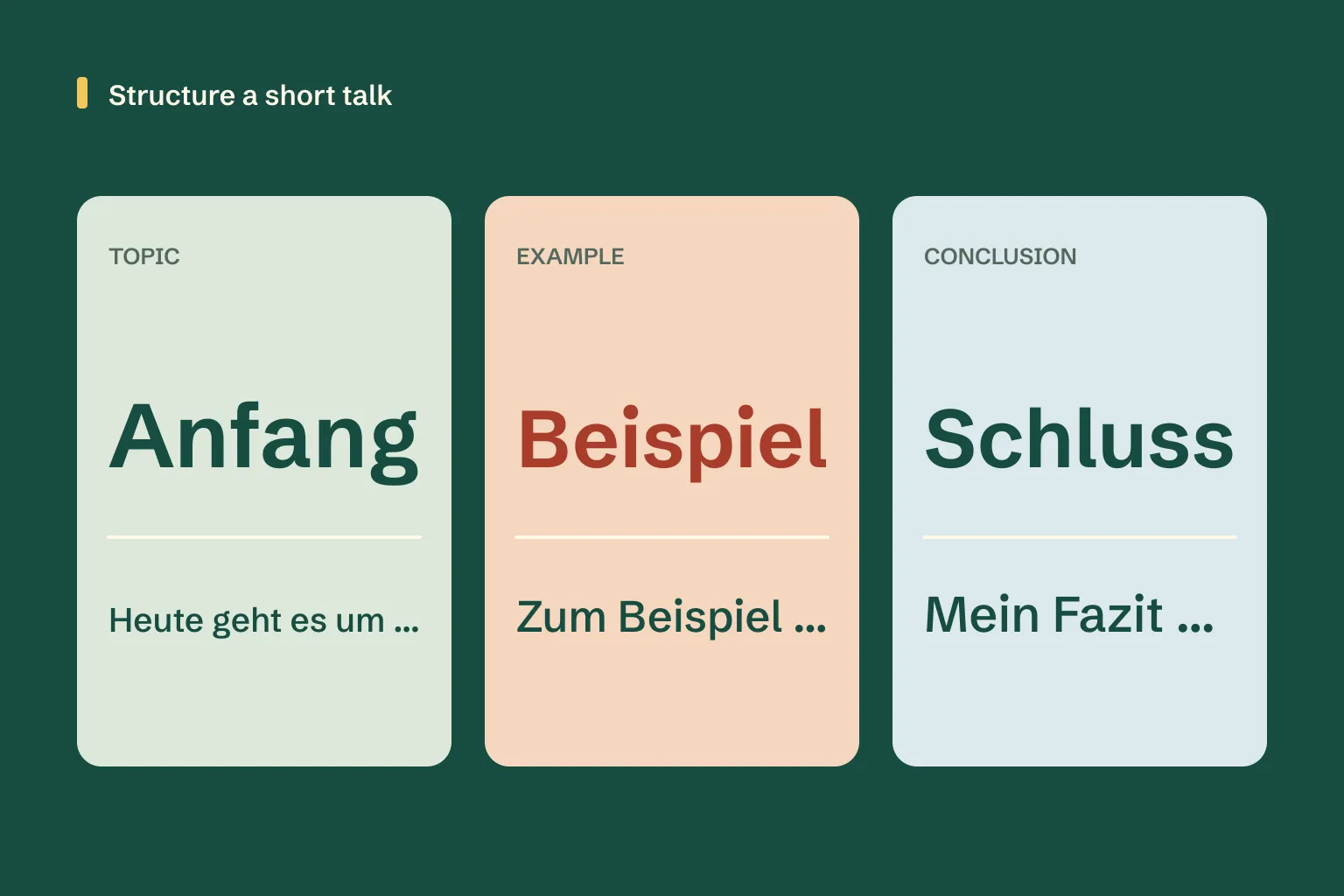
Your teacher asks you to speak for about two minutes about a familiar topic. Do not start by memorizing a long introduction. First decide what your listener should understand by the end. A clear short presentation has a topic, a small number of connected points, a concrete example and a conclusion. Practise speaking from keywords so you can respond when somebody asks a question.
Takeaway: Plan one message, two points and one example. The order should help a listener follow your meaning, even if they cannot see your notes.
Choose a question you can answer from experience
For this original practice lesson, use Wie kann eine kleine Lerngruppe vor dem Deutschkurs zusammenarbeiten? The speaker’s message is that a short, prepared meeting works better for this fictional group than an open-ended session.
This is an editorial B1 activity, not an official CEFR assessment. The two-minute target is a practice constraint. It is not a universal requirement for every B1 class or exam. A slower pace, simpler sentences or a different topic may be more appropriate for your current course.
An original presentation model
Heute möchte ich darüber sprechen, wie eine kleine Lerngruppe vor dem Deutschkurs zusammenarbeiten kann. In meiner Gruppe treffen wir uns manchmal zwanzig Minuten vor der Stunde. Für uns ist wichtig, dass jeder eine kleine Aufgabe vorbereitet.
Zuerst wählen wir ein Thema aus der letzten Stunde. Dann bringt jede Person zwei Beispielsätze mit. Wir lesen die Sätze vor und sagen, welche Wörter wir noch schwierig finden. Zum Beispiel haben wir letzte Woche über Termine gesprochen. Ich habe einen Satz mit „verschieben“ vorbereitet und meine Partnerin hat erklärt, wann sie dieses Wort benutzt.
Ein Vorteil ist, dass wir konkrete Fragen für den Kurs sammeln. Außerdem merken wir, ob unsere Beispiele verständlich sind. Allerdings können wir nicht jede Grammatikfrage selbst beantworten. Solche Fragen schreiben wir auf und besprechen sie später mit der Lehrerin.
Mein Fazit ist deshalb: Eine kurze Lerngruppe ist für uns hilfreich, wenn wir ein klares Thema haben. Sie ersetzt den Unterricht nicht, aber sie hilft uns, vorbereitet in die Stunde zu gehen. Vielen Dank fürs Zuhören. Welche Erfahrungen habt ihr mit Lerngruppen?
The group and experience are fictional. The speaker does not claim that this method works for every learner. Notice für uns and wenn wir ein klares Thema haben: they keep the conclusion specific.
Turn the model into a keyword card
| Section | Keywords, not full sentences |
|---|---|
| Opening | Lerngruppe; zwanzig Minuten; vorbereiten |
| Point one | Thema wählen; zwei Beispielsätze |
| Example | Termine; verschieben; Partnerin erklärt |
| Point two | Fragen sammeln; Grenzen erkennen |
| Conclusion | klares Thema; Unterricht ergänzen |
Speak once using only this card. Then change the example to a different real or clearly fictional course topic. If you cannot continue without the full script, shorten the sentence rather than adding more text to the card.
A card with forty complete sentences is a script in a small font. The purpose of keywords is to preserve the route while allowing natural wording. You do not need to reproduce the model word for word.
Help the listener hear the structure
Zuerst, dann, außerdem and mein Fazit signal where you are going. Choose a few that match the relationship. Deshalb should introduce a conclusion supported by the earlier points, not a completely new topic.
Pause after the opening question and before the conclusion. In your notes, mark a slash where you want a short pause: Ein Vorteil ist / dass wir konkrete Fragen sammeln. The slash is a speaking reminder, not German punctuation for the final written text.
If a word is missing, use a short repair: Ich meine damit … or Das Wort fällt mir gerade nicht ein. Es geht um … A repair that preserves meaning is more useful than stopping the whole presentation to search for one perfect noun.
Prepare for two follow-up questions
Possible question: Was macht ihr, wenn niemand die Antwort kennt? A model response is Dann schreiben wir die Frage auf und fragen später im Kurs nach.
Possible question: Müssen alle immer teilnehmen? A model response is Nein, in unserer Gruppe ist das freiwillig. Wer keine Zeit hat, kann seine Beispiele später schicken. This second fact is a possible fictional extension, not information explicitly supplied by the presentation. In a comprehension task, distinguish stated facts from an imagined answer.
Listen to the question before choosing your prepared phrase. If it is unclear, ask Meinst du die Vorbereitung oder das Treffen selbst? You can clarify without pretending you heard something you did not.
Six tasks
- What is the presentation’s main recommendation? Use one sentence.
- Which part supplies a concrete example rather than only a general claim?
- Does the model claim the group can solve every grammar question?
- Shorten this note into keywords: Zuerst wählen wir ein Thema aus der letzten Stunde und jede Person bringt zwei Beispielsätze mit.
- Answer Wann trefft ihr euch vor dem Kurs? using only a fact explicitly stated in the model.
- Prepare a new short talk: Ein Ort, an dem ich gern Deutsch übe. Give one main message, two reasons, one specific example and a conclusion. Use true details or label the scene fictional.
Answers and model guidance
- A short, prepared group meeting can help this group if it has a clear topic. The qualification is part of the message.
- The example about appointments and verschieben. It shows what the participants actually bring and discuss.
- No. Unanswered questions are recorded and taken to the teacher.
- Model card: Thema letzte Stunde / zwei Beispielsätze pro Person. Other short notes work if they preserve the order.
- Wir treffen uns manchmal zwanzig Minuten vor der Stunde. The model states when the group meets relative to class. It does not explicitly state how long the meeting lasts.
- Fictional model: Heute möchte ich einen Ort vorstellen, an dem ich gern Deutsch übe: meinen Küchentisch am Abend. Für mich ist er praktisch, weil es nach dem Essen meistens ruhig ist. Außerdem liegen mein Heft und mein Wörterbuch schon dort. Zum Beispiel habe ich gestern fünf Sätze über einen Termin geschrieben. Danach habe ich die Zeitangaben geprüft und einen Fehler verbessert. Für Gespräche ist der Tisch nicht immer geeignet, weil meine Familie das Zimmer auch benutzt. Dann verabrede ich mich lieber mit meiner Partnerin an einem anderen Ort. Mein Fazit ist: Für kurze Schreibaufgaben ist der Küchentisch für mich hilfreich, wenn ich ihn in Ruhe nutzen kann. Your location and reasons may differ. Include a main message, two reasons, a specific example and a conclusion. Use true details or label the scene fictional; do not generalize the example to every learner.
Sources and next practice
Checked on 19 October 2026: Council of Europe global scale and Goethe’s B1 description, which provide broad context for connected speaking, familiar topics and brief reasons. The structure, duration and examples are original teaching choices.
Use the class vocabulary phrase guide to prepare a few useful chunks, then return to the B1 learning path.