
Classroom companion
Agree and disagree in German: a B1 discussion lesson
Practise agreeing, disagreeing and proposing a compromise in German. Includes a complete B1 class dialogue, useful responses and six tasks with models.
Read as Markdown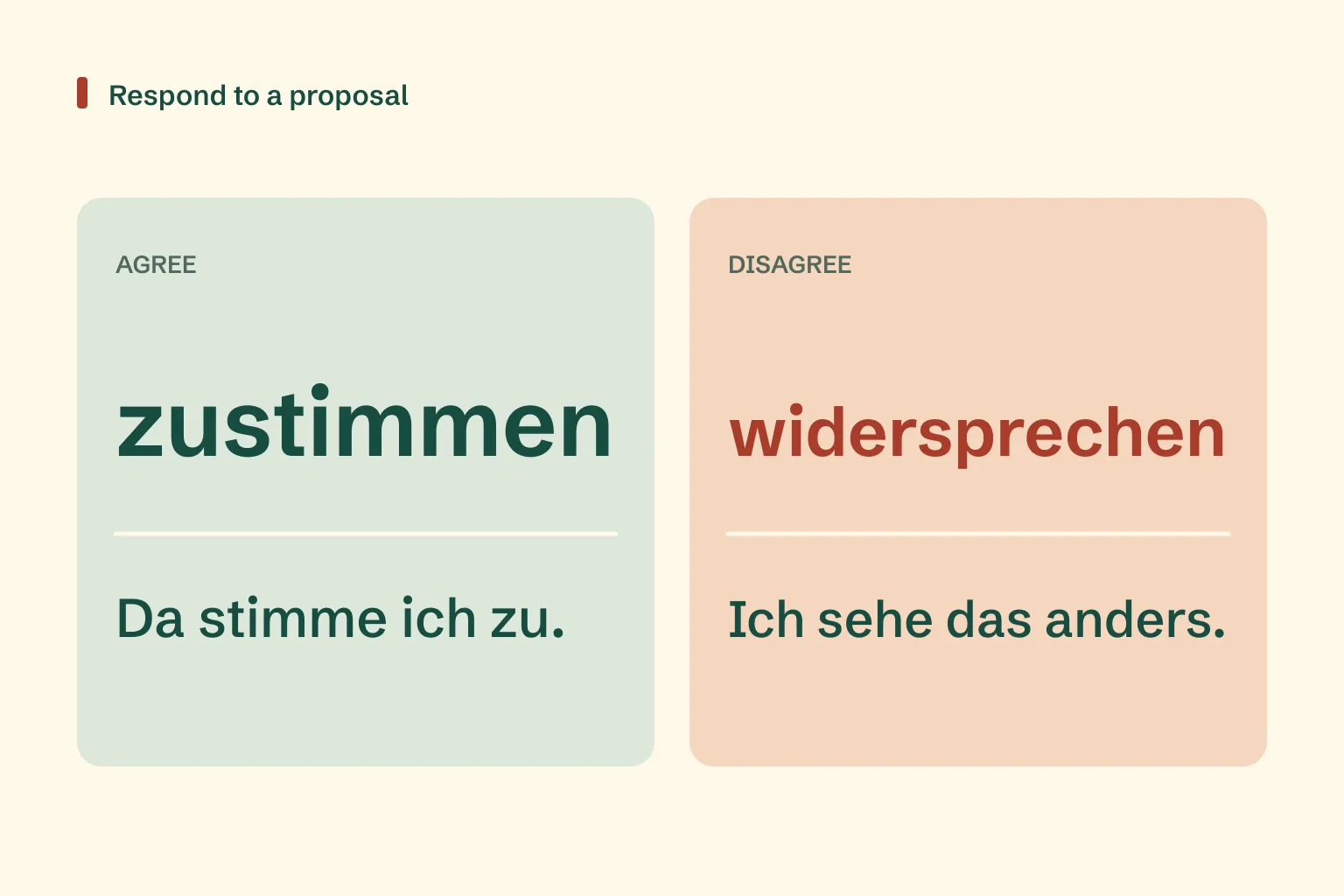
During group work, a partner proposes meeting online every week. You partly agree, but you also want some meetings in the classroom. To join the discussion, show which point you understood, explain your own view and suggest a next step. You do not need to win an argument; you need to make your meaning clear while responding to another person.
Takeaway: Use three moves: acknowledge a point, give a reason, offer a workable alternative. Agreement and disagreement can both be specific and courteous.
A complete original discussion
Three classmates are deciding how to rehearse a short presentation. All names and details are fictional.
Mara: Ich schlage vor, dass wir jede Woche online üben. Dann muss niemand nach dem Kurs länger bleiben.
Jonas: Da stimme ich dir zu. Ich habe nach dem Kurs oft wenig Zeit. Online können wir uns auch später treffen.
Elif: Das stimmt. Trotzdem würde ich gern einmal zusammen im Kursraum üben. Dann sehen wir besser, wo wir stehen und wie laut wir sprechen müssen.
Mara: Du meinst also, dass wir nicht nur den Text, sondern auch den Auftritt üben sollten?
Elif: Genau. Für die Wörter ist ein Onlinetreffen praktisch. Aber beim Zeigen der Bilder möchte ich sehen, ob alle etwas erkennen können.
Jonas: Das kann ich verstehen. Allerdings kann ich dienstags nicht länger bleiben. Können wir die gemeinsame Probe auf Donnerstag legen?
Mara: Donnerstag passt mir. Wie wäre es, wenn wir diese Woche online üben und uns nächste Woche vor dem Kurs im Raum treffen?
Elif: Damit bin ich einverstanden. Dann können wir die Aufgaben bis zum Onlinetreffen verteilen.
Jonas: Gut. Ich schicke euch heute Abend zwei mögliche Uhrzeiten.
The group does not simply exchange prepared opinions. Mara checks Elif’s meaning, Jonas names a real constraint, and the final turn states who will do what next. That makes the discussion usable.
Agree with a particular point
| Move | Useful phrase | Original continuation |
|---|---|---|
| Clear agreement | Da stimme ich dir zu. | Online sparen wir den Weg. |
| Partial agreement | Das stimmt, aber … | … eine Probe im Raum wäre trotzdem wichtig. |
| Acknowledge a concern | Das kann ich verstehen. | Nach dem Kurs bist du oft müde. |
| State a different view | Ich sehe das etwas anders. | Für mich ist eine kurze Probe vor Ort leichter. |
| Ask for a reason | Warum findest du das praktischer? | Meinst du den Termin oder die Vorbereitung? |
| Suggest compromise | Wie wäre es, wenn …? | … wir beide Möglichkeiten nutzen? |
Da stimme ich dir zu refers to a point already made. Dir is dative. For formal address, use Ihnen: Da stimme ich Ihnen zu. Match the relationship in the actual setting; this class dialogue uses informal du/ihr.
Disagree without rejecting the person
Compare Das ist falsch! with Bei diesem Punkt sehe ich es anders, weil wir die Bilder im Raum besser testen können. The second names the point and gives a reason. It leaves room for a response.
This is not a rule that strong disagreement is always impolite. The purpose of this exercise is to practise a collaborative class decision. A specific concern is more useful here than an attack on somebody’s intelligence or motivation.
Avoid saying Ja, genau when you actually mean “I understand your point, but disagree.” You can say Ich verstehe deinen Vorschlag. Für mich ist aber … wichtig. Understanding and agreement are different moves.
Ask a question before answering a different proposal
Mara says Du meinst also, dass …? to check her interpretation. This prevents her from arguing against an idea Elif did not express. You can also use Habe ich dich richtig verstanden? followed by a short restatement.
If you do not understand a word, ask directly: Was meinst du mit „Auftritt“? That is a better response than memorizing a long opinion while missing the topic. The useful classroom chunk is mit etwas meinen, as in Was meinst du damit?
Run a twelve-minute practice discussion
Take this new decision: your group can practise in a quiet library room that requires booking or in a café that needs no booking but may be noisy. Spend two minutes choosing one preference and a reason. Discuss for four minutes. Switch preferences and discuss for another four minutes. Use the final two minutes to record one agreement and one action.
The role switch checks whether you can respond to reasons rather than repeat a fixed speech. You may change the outcome. A good compromise must fit the fictional constraints, not match one “correct” personal opinion.
Six tasks
- Why does Elif want a rehearsal in the classroom?
- Does Jonas reject every classroom rehearsal? Point to the actual constraint.
- Complete: Da stimme ich ___ zu. Use the informal person du.
- Replace the blunt response Dein Vorschlag ist schlecht with a specific disagreement about café noise.
- Ask whether you understood this proposal correctly: meet online this week and in person next week.
- Write a final decision for the library/café task. Include the place, a reason and a named next action. Either choice can work.
Answers and models
- She wants to test positioning, speaking volume and whether the pictures are visible. The physical presentation is the concern, not just vocabulary.
- No. He cannot stay later on Tuesdays. He suggests Thursday, so he remains open to an in-person option.
- Dir. Jemandem zustimmen takes dative: Ich stimme dir zu.
- One model: Ich sehe das etwas anders, weil es im Café zu laut sein könnte. In der Bibliothek könnten wir uns besser hören. Other courteous, specific reasons are acceptable.
- Habe ich dich richtig verstanden? Du möchtest diese Woche online üben und dich nächste Woche persönlich treffen? A shorter restatement is fine if it preserves both weeks.
- Library model: Wir üben in der Bibliothek, weil wir dort in Ruhe sprechen können. Mara fragt heute nach einem freien Raum. Café model: Wir treffen uns im Café, weil wir kurzfristig üben möchten. Jonas fragt vorher, wann es dort ruhig ist. Neither is universally best; the reason and action must fit the choice.
Sources and next practice
Checked on 19 October 2026: Duden, zustimmen for the dative pattern; Goethe’s B1 skill description for broad interaction context. This original lesson is not an official exam simulation, and B1 is an editorial estimate.
Try the published B1 group-project story for another shared decision, or return to the B1 learning path.