
Classroom companion
Fact, opinion and evidence: a B2 German reading lesson
Distinguish a stated fact, personal evaluation and unsupported inference in an original German B2 reading, with transparent fictional numbers and explained answers.
Read as Markdown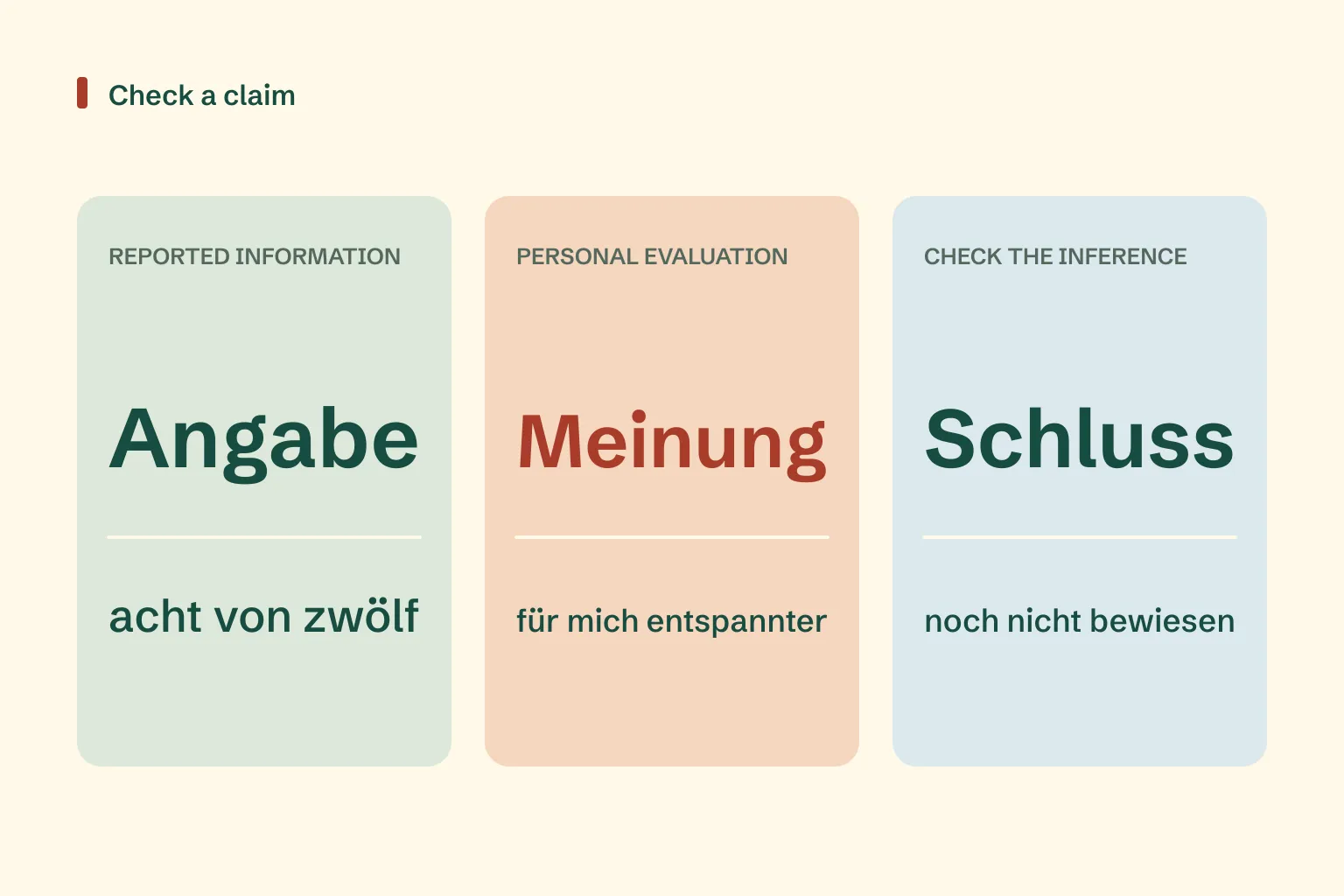
A German text may mix reported numbers, personal preferences and conclusions. Ask three questions: what exactly is stated, who says it and how far the evidence supports the conclusion. A claim can be checkable without being verified, and an opinion can be relevant without describing everyone. Use the original fictional text below to practise those distinctions.
Takeaway: Acht von zwölf Antworten and eine Mehrheit aller zwanzig Mitglieder are different claims. Keep the denominator visible.
Original reading text
The club, survey and all numbers are invented teaching material. They are not market research, search data or findings about real learners. The B2 level is an editorial estimate.
Eine Umfrage ist noch keine Entscheidung
Der erfundene Kursverein Wortgarten überlegt, seine wöchentliche Übungsrunde vom Dienstag auf den Donnerstag zu verlegen. Die Organisatorin hat dazu einen kurzen Fragebogen an die zwanzig Mitglieder geschickt. Zwölf Personen haben geantwortet. Acht davon bevorzugen Donnerstag, drei möchten Dienstag behalten und eine Person hat keine Präferenz angegeben. Diese Zahlen wurden ausschließlich für diese Leseübung erfunden.
In der nächsten Sitzung sagt ein Mitglied: „Die große Mehrheit des Vereins will Donnerstag. Damit ist die Sache eigentlich klar.“ Ein anderes Mitglied widerspricht. Acht Stimmen seien zwar innerhalb der zwölf Antworten die größte Gruppe, aber acht Personen seien noch keine Mehrheit aller zwanzig Mitglieder. Außerdem sei unklar, warum die übrigen acht nicht geantwortet haben. Vielleicht hätten sie die Nachricht nicht gesehen oder ihre Arbeitszeiten noch nicht gekannt.
Die Organisatorin ergänzt eine Beobachtung: An zwei der letzten vier Dienstage seien nur sechs Personen gekommen. Daraus schließt sie zunächst, dass Dienstag grundsätzlich ungeeignet sei. Auf Nachfrage erinnert sie sich jedoch, dass an einem dieser beiden Tage ein wichtiger Termin in der Stadt stattgefunden hatte. Ob dieser Termin die geringere Teilnahme erklärt, wurde nicht untersucht. Auch die Teilnahme an den anderen beiden Dienstagen wird in der Sitzung zunächst nicht genannt.
Eine Teilnehmerin berichtet, sie fühle sich donnerstags entspannter und könne dann aufmerksamer zuhören. Das ist eine persönliche Erfahrung, aber keine Aussage darüber, wie alle anderen den Donnerstag erleben. Für einen Kollegen ist derselbe Abend schwierig, weil er dann einen langen Arbeitsweg hat. Beide Erfahrungen sind für die Planung relevant, auch wenn sie einander nicht widersprechen müssen.
Am Ende beschließt die Gruppe, die bisherige Schlussfolgerung noch nicht als endgültige Entscheidung zu behandeln. Die Organisatorin fragt die fehlenden Personen erneut und bietet zusätzlich die Möglichkeit an, einen Grund für die Präferenz zu nennen. Danach will die Gruppe prüfen, ob ein wechselnder Termin praktikabel wäre. Auch dafür fehlen noch Angaben, etwa zur Raumverfügbarkeit.
Die Diskussion hat das Terminproblem nicht sofort gelöst. Sie hat aber gezeigt, welche Aussagen durch die vorhandenen Informationen gestützt werden und welche nur vermutet wurden. Ein klar formulierter Zweifel hat hier mehr zur Planung beigetragen als eine schnelle Behauptung im Namen aller.
Eight useful critical-reading chunks
| German | English meaning |
|---|---|
| einen Fragebogen verschicken | send a questionnaire |
| eine Präferenz angeben | state a preference |
| einer Aussage widersprechen | challenge a statement |
| innerhalb der Antworten | within the responses |
| daraus schließen | conclude from that |
| auf Nachfrage | when asked further |
| eine Vermutung | an assumption, conjecture |
| durch Informationen gestützt | supported by information |
Label the claim before judging it
A reported count is a statement that could be checked against records: twelve people responded. Within this fiction, the narrator supplies it as a fact. In a real text you would still ask how the responses were collected and whether the record is reliable.
A personal evaluation expresses a view, such as feeling more relaxed on Thursday. It can guide planning for that person without proving that every member is more attentive then. An inference goes beyond the immediate observations: low attendance twice means Tuesday is fundamentally unsuitable. That inference needs more support than the text provides.
Do not use “opinion” to dismiss every claim you dislike. A statement may be factually testable and false, or testable but currently unverified. The useful task is to identify the claim’s status and what evidence would support it.
Follow the qualifiers
Vielleicht marks a possibility. The text gives possible reasons for nonresponse but does not establish one. Grundsätzlich ungeeignet is broader than the two observed Tuesdays. Zunächst signals that a first interpretation later changes.
The reported Konjunktiv forms seien and hätten help attribute some statements to speakers; they do not by themselves label the statements false. You can understand the argument by tracking who owns each claim without turning this reading into a full reported-speech lesson.
Questions and evidence checks
- How many members are in the club, and how many answered?
- How many prefer Thursday? Is that a majority of respondents and a majority of all members?
- Give one personal evaluation from the text and explain its scope.
- Which conclusion about Tuesday goes beyond the supplied attendance evidence?
- Does the text establish why eight members did not respond?
- What information about the other two Tuesdays would help assess the attendance claim?
- Rewrite “Everyone wants Thursday” as an accurate German statement using only the supplied counts.
- Give a two-sentence German conclusion that preserves the open decision.
Explained answers and models
- Twenty members; twelve responses. Nonresponse involves eight members, not eight votes for Tuesday.
- Eight prefer Thursday. Eight of twelve is more than half of respondents; eight of twenty is less than half of all members. The two denominators produce different majority claims.
- One participant feels more relaxed on Thursday and able to listen more attentively. It concerns her experience. It does not establish every member’s state.
- That Tuesday is fundamentally unsuitable. Two low-attendance dates, with incomplete contextual information, do not settle that general claim.
- No. The possible reasons are marked as possibilities; treating one as confirmed would add evidence that is absent.
- The attendance numbers and any relevant circumstances on those days. That would provide a fuller comparison, though it still would not alone establish causation.
- Acht von zwölf antwortenden Personen bevorzugen Donnerstag; insgesamt hat der Verein zwanzig Mitglieder. Another accurate version may add the three Tuesday preferences and one neutral response.
- Die bisherigen Antworten sprechen unter den Antwortenden eher für Donnerstag, reichen aber nicht für eine Aussage im Namen aller Mitglieder. Vor einer endgültigen Entscheidung sollen weitere Rückmeldungen und die Raumverfügbarkeit geprüft werden. More concise wording is valid if it avoids a final decision or a universal preference.
Sources and next practice
The Council of Europe’s CEFR, section 4.4.2.4 on cues and inference supports checking an interpretation against context. Goethe’s B2 reading materials offer separate official reading practice. This original text’s reasoning exercise is not a validated research instrument or an exam score. Continue in the B2 path.