
Classroom companion
Telling the time in German: formal and everyday clock times
Tell German clock times in the 24-hour system and everyday speech, understand halb, and confirm a class start time without regional ambiguity.
Read as Markdown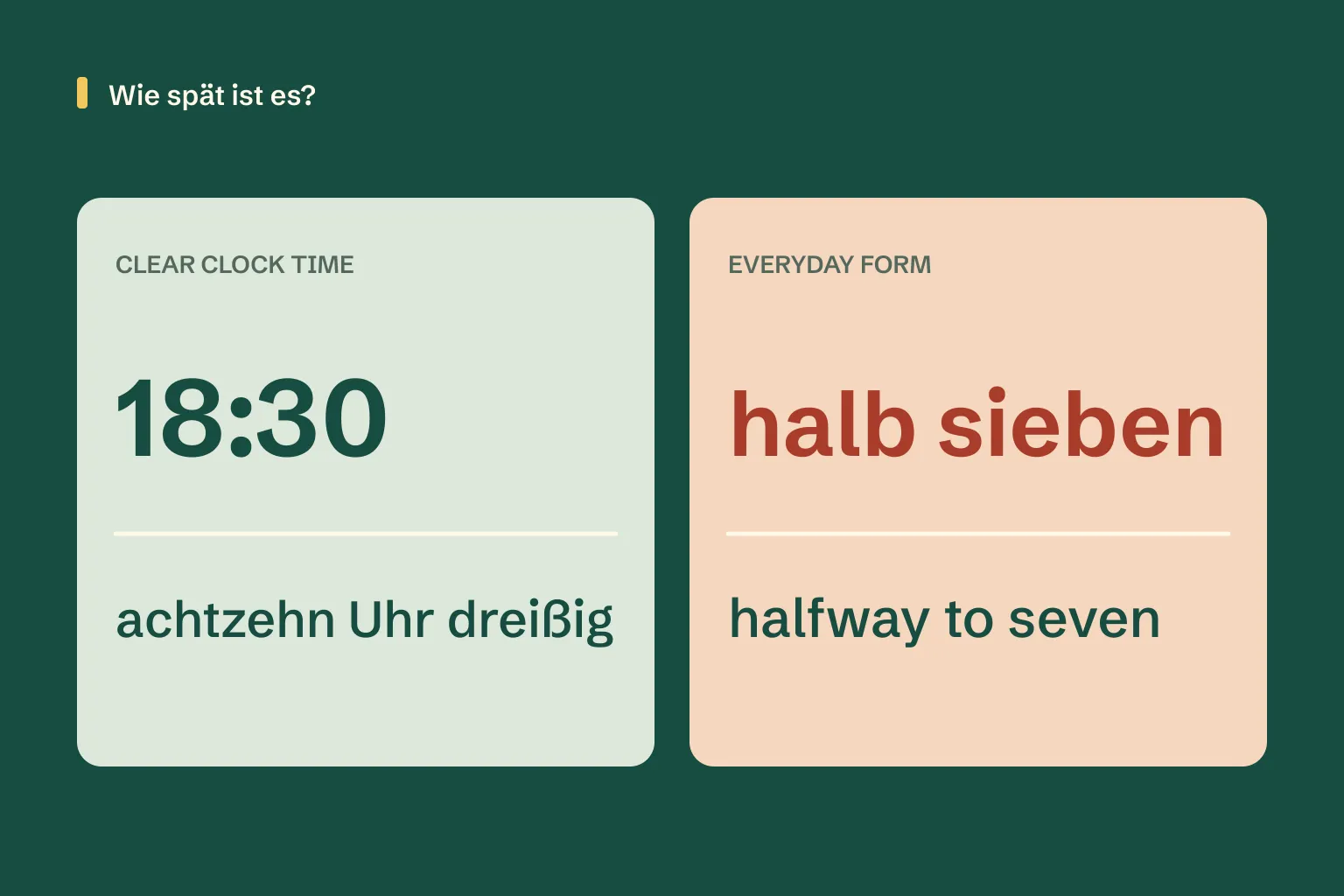
A classmate says halb sieben, but your timetable says 18:30. They can refer to the same evening time: German halb sieben is half an hour before seven, or 6:30. Use the clear 24-hour form when arranging a class, then learn the everyday forms you may hear. Confirm the part of the day whenever a twelve-hour expression could be unclear.
Takeaway: Halb sieben = 6:30, not 7:30. For an appointment, achtzehn Uhr dreißig states 18:30 precisely.
Read a timetable time
| Clock | 24-hour spoken form | English |
|---|---|---|
| 08:00 | acht Uhr | eight a.m. |
| 08:05 | acht Uhr fünf | eight oh five a.m. |
| 12:15 | zwölf Uhr fünfzehn | twelve fifteen p.m. |
| 18:30 | achtzehn Uhr dreißig | six thirty p.m. |
| 19:45 | neunzehn Uhr fünfundvierzig | seven forty-five p.m. |
| 21:10 | einundzwanzig Uhr zehn | nine ten p.m. |
Say the hour, Uhr, then minutes. You do not need an English-style “hundred hours” phrase. At exactly one o’clock, the usual form is ein Uhr, with ein, rather than eins Uhr. If the clock has no minutes displayed, acht Uhr is complete.
Wie spät ist es? and Wie viel Uhr ist es? both ask the current time. Answer with Es ist …: Es ist acht Uhr fünf. To ask when something happens, use Wann beginnt der Kurs? (When does the course start?). Answer with um: Der Kurs beginnt um achtzehn Uhr dreißig. Es ist and um do different jobs.
Everyday time: nach, vor and halb
| Time | Everyday form | Literal idea |
|---|---|---|
| 6:10 | zehn nach sechs | ten past six |
| 6:15 | Viertel nach sechs | quarter past six |
| 6:30 | halb sieben | halfway to seven |
| 6:45 | Viertel vor sieben | quarter before seven |
| 6:50 | zehn vor sieben | ten before seven |
These twelve-hour expressions need context. Halb sieben am Morgen specifies 6:30 in the morning; halb sieben am Abend specifies 18:30. If someone says only halb sieben, ask Morgens oder abends? (In the morning or in the evening?) when the plan is unclear.
Regional expressions such as viertel sieben or dreiviertel sieben also occur. This lesson does not ask you to use them. When you hear an unfamiliar form, give a clock-time confirmation rather than assuming it follows your own region’s pattern: Meinst du achtzehn Uhr fünfzehn? (Do you mean 18:15?). A confirmation is a communication skill, not a sign of failure.
An original class-planning exchange
Nora: Wann beginnt unser Kurs? When does our course start?
Tariq: Um halb sieben am Abend. At half past six in the evening.
Nora: Also um achtzehn Uhr dreißig? So, at 18:30?
Tariq: Ja. Wir treffen uns um achtzehn Uhr zwanzig vor dem Raum. Yes. We meet at 18:20 outside the room.
The confirmation separates the meeting time from the class time. Write both labels in your notes: Treffen 18:20; Kurs 18:30. If you record two times without their purposes, you can arrive on time for the wrong event.
Practise with paper clocks or written times. A1 is the suggested practice level, and the forms here cover everyday clock times rather than the full range of time expressions.
Practise it
- Write 17:10 in the 24-hour spoken form.
- Choose the clock matching halb neun: 8:30 or 9:30.
- Say 6:45 using Viertel vor.
- Complete: Der Kurs beginnt ___ 18 Uhr.
- Your partner says halb sieben without context. Ask a brief German question to clarify morning or evening.
- Using the fictional plan, write two complete German sentences, one for meeting and one for class start. Keep the labels distinct.
Answers and reasons
- Siebzehn Uhr zehn. Hour, Uhr, then minutes.
- 8:30. Halb points toward the next hour, neun.
- Viertel vor sieben. It is one quarter-hour before seven.
- Um. It introduces the time when the event starts; Es ist would instead state the current time.
- Morgens oder abends? A fuller alternative is Meinst du morgens oder abends?
- Wir treffen uns um achtzehn Uhr zwanzig. Der Kurs beginnt um achtzehn Uhr dreißig. These preserve both different times. Writing numerals with Uhr is also acceptable for the planning note.
Use it in your next lesson
Write the start time of a fictional class in both forms: 19:30 → neunzehn Uhr dreißig → halb acht am Abend. Cover one form and recover it from the other. Save the whole phrase um halb acht, not just halb, beside your course vocabulary. The A1 path offers linked time and number practice.
Sources and further reading
- UT: telling time: Reference for 24-hour time and the everyday vor, nach and halb patterns.
- Goethe-Institut A1 vocabulary: Reference for clock-time vocabulary and number forms used in beginner time expressions.